
Quinoline derivatives are popular in medicine to treat cancer, malaria, tuberculosis and other parasitic infections [1]. As well they are used in organic photovoltaic electronics as cell dyes because of their fluorescent properties [2]. Good fluorescent properties of quinoline derivatives with EQE $ \sim 15\% $ [3] can be exploited as emissive layer in the organic light emitting devices (OLEDs).
Driven by this idea we decided to explore luminescence and electrical properties of the OLEDs with quinolone derivatives as emissive layer. These quinolone compounds with chlorine substituent were synthesised in Faculty of Chemistry of Vilnius University.
OLEDs were formed using thermal evaporation in the high vacuum. A principal structure of these organic devices is shown in Fig. 1 on the left. Energies of all formed OLED layers are known from literature [4, 5, 6] and are shown in Fig. 1 on the right. OLEDs were formed on a glass with transparent indium tin oxide (ITO) electrode as follows. First, 15 nm hole transporting layer (HTL) was formed from N,N'-Bis(3-methylphenyl)-N,N'-diphenylbenzidine (TPD). After that the emissive layer (EL) of one quinoline derivative with chlorine substituents was evaporated. The hole blocking layer (20 nm) was evaporated of 1,3,5-tris(m-pyrid-3-yl-phenyl) benzene (TmPyPB) to prevent holes leakage in the EL. Then electron transporting layer (ETL) was formed using 15 nm of aluminium 8-hydroxyquinolinate (Alq3) material. Lastly, cathode (LiF with Al) was formed. The j-V characteristics, electroluminescence and photoluminescence (PL) properties of these made devices were measured.
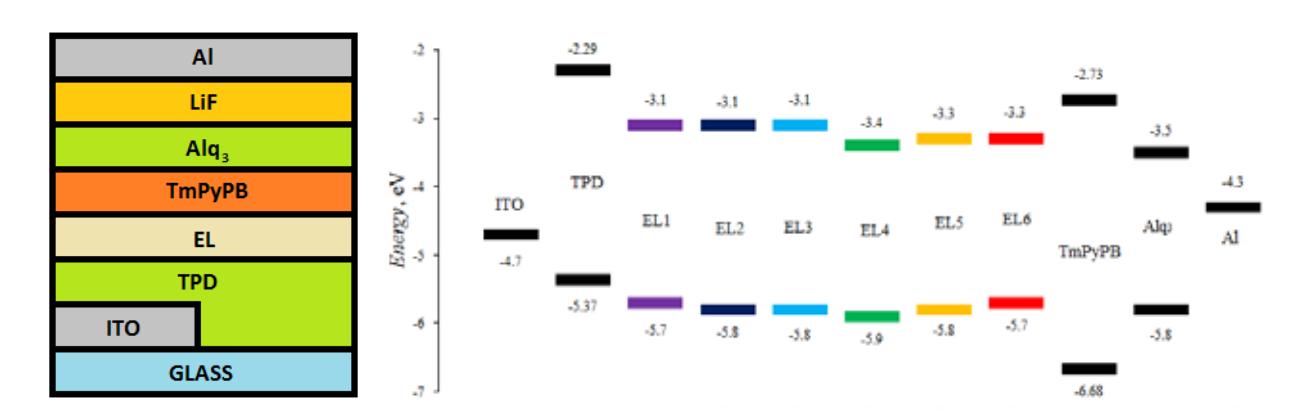
The investigation of electroluminescence spectra allowed us to evaluate, which materials are appropriate for OLED's fabrication. The PL and electroluminescence of all ELs with the quinoline derivatives varied from 470 nm to 500 nm. These results satisfy the values of the optical band gap ($E_{\rm g\_opt}$) of the quinoline derivatives except material EL6. The $E_{\rm g\_opt}$ for EL6 material is 2.4 eV which corresponds to luminescence at 516 nm range. But OLED with EL6 layer electroluminescated in 490 nm. Some of results were not as expected due to charge transport singularities and different thicknesses of the ELs in the formed OLED structures.
All in all we investigated j-V characteristics, PL and electroluminescence properties of OLED devices with the ELs of the quinoline derivatives with chlorine substituent and showed that EL properties depend on chemical structure of the chlorine substituent as well on charge transport peculiarities in the OLEDs.