
In recent years, considerable interest has been devoted to fabrication of various ferrite nanoparticles (Nps) with the aim of developing the convenient method for synthesis of uniform Nps with predictable size, morphology and homogeneity [1]. This need is dictated by the increasing interest in application of superparamagnetic nanoparticles and ferrofluids in catalysis, waste water treatments and nanomedicine, in particular, diagnostics, magnetic hyperthermia, drug delivery systems, etc. [2].
This study is focused on the synthesis of manganese ferrite (MnFe2O4) Nps by most commonly used chemical way pursuing better control of their size, purity and magnetic properties. Co-precipitation syntheses were performed using aqueous alkaline solutions of Mn(II) and Fe(III) salts and NaOH within a wide pH range using various hydrothermal treatment regimes. Different additives, such as cysteine, glycine, chitosan, polypropylene glycol, etc., were tested on purpose to obtain good yield of pure phase and monodispersed Nps with average size of $\leq$ 20 nm. X-ray diffraction (XRD), Mössbauer spectroscopy down to cryogenic temperatures and magnetic measurements were utilized in this study.
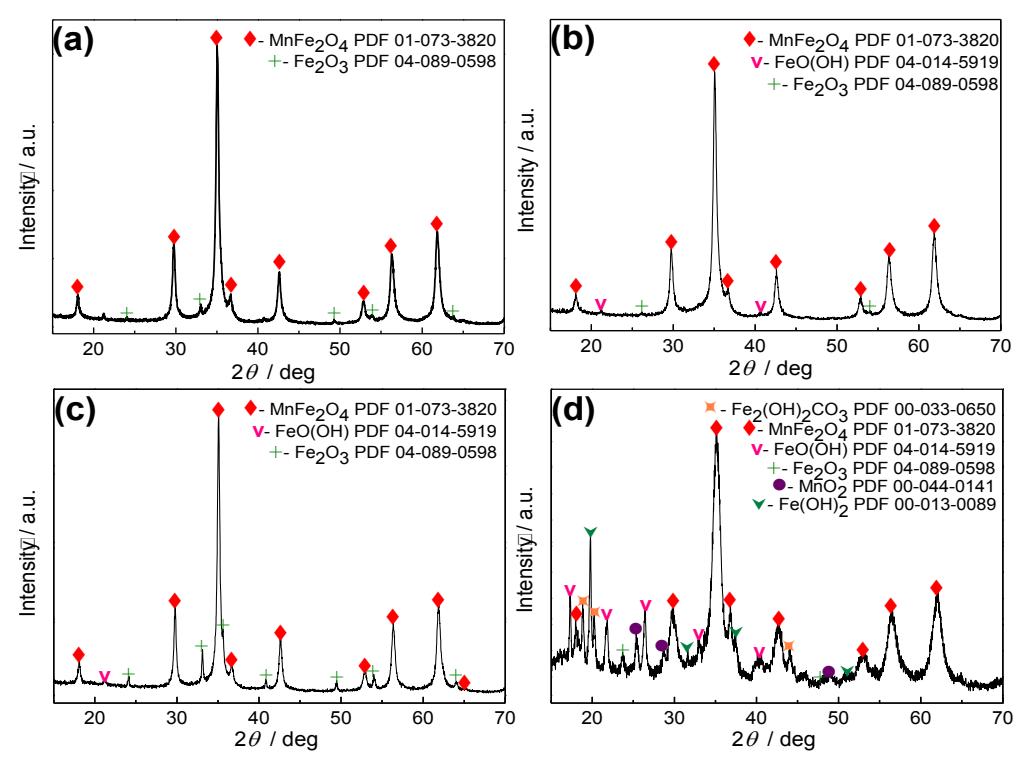
It was determined that the majority of tested chelating and Mez+ complexing additives, besides the expected control of the particle size and size dispersity, also have a strong effect on the purity of the product obtained by hydrothermal as well as microwave-assisted synthesis by co-precipitation reaction of Mn(II) and Fe(III) ions. Therefore, the application of such additives as cysteine, glycine, chitosan and their salts for the synthesis of pure phase MnFe2O4 nanoparticles is not suitable. On the other hand, the influence of the tested additive PPG, on the purity of the synthesized Nps is significantly weaker, therefore PPG can be used for the production of superparamagnetic MnFe2O4 Nps with a good yield.