
1,3,4-oxadiazoles are a class of significant heterocyclic compounds used in medicinal and pesticide chemistry, asymmetric organic synthesis, and polymer and materials science. 2,5-Diaryl-1,3,4-oxadiazoles are important materials used as red luminescent emitters with carrier-transporting ability, efficient electron transporting and hole blocking materials in organic light-emitting diodes (OLEDs )[1] The 1,3,4- and 1,2,4-oxadiazole moieties have been incorporated to many series of organic compounds due to their interest as electron transporting materials or their application in emission layers for OLEDS and in biology. Oxadiazole units have been extensively incorporated in dendrons and dendrimers to study their luminescent properties in nonmesomorphic materials. The highly branched structure of the dendrimer may improve the luminescence efficiency of the materials in films since their globular shape reduces intermolecular interactions. The well-defined architecture of dendrimers enables for the specific and controlled location of the oxadiazole moieties in the dendritic scaffold, and this feature favors the supramolecular organization required to obtain mesomorphic properties [2].
In this work we simulate spectral properties of 1,3,4-oxadiazole monomers and dimers (Fig. 2) by means of quantum chemical methods in order to explain the experimental spectra results of oxadiazole in chloroform solution and in thin films. Experimental spectra were provided by prof. V. Gulbinas group from Lithuanian Center of Physical Sciences and Technology.
Molecular ground-state structures of photochromic monomer and dimer were obtained by optimizing geometric parameters of investigated compounds. All optimizations were performed using electronic structure modeling suite Gaussian09 [3]. DFT method [4-6] with hybrid functionals B3LYP, CAM-B3LYP, LC-BLYP and PBE1PBE and 6-31(2,p) basis set were used for optimization. Electronic excitation energy calculations were then carried out at the optimized geometries using TD-DFT and 6-31(2,p) basis set as implemented in Gaussian09. Vilnius University Faculty of Physics supercomputer [7] was used in this work.
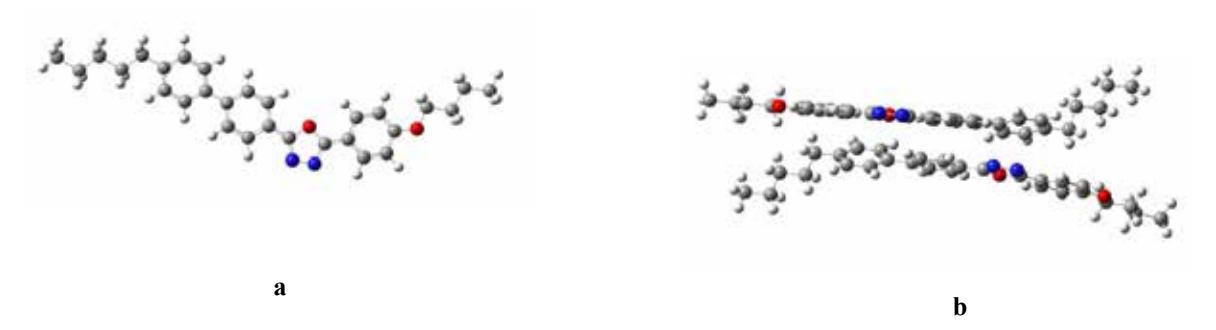
The TD-DFT calculations at b3lyp/631G(d,p) level reproduces the experimental absorption and fluorescence spectra of monomers and dimers in chloroform solutions (337 nm in absorption spectra and about 400 nm in fluorescence spectra in solutions). Experimental maximums at 400 nm and 550 nm in fluorescence spectra in PEI polymer thin films were not achieved by modeling chromophore dimers at equilibrium positions. The fluorescence spectra of PEI polymer thin films were reproduced when thin film was modelled by placing two separately optimized dimers in S0 and S1 states at closer distances (about 2 Å). On the ground of our theoretical simulations we can conclude that 550 nm band in fluorescence spectrum of polymers is caused by interaction of electronic systems of chromophores in S0 and S1 states.