
Organic materials with fluorescence in visible spectrum are investigated extensively due to their potential application in organic optoelectronics. For instance, perylenediimides (PDIs) are materials of high photo and thermal stability, high fluorescence quantum yields and chemical inertness. Therefore, they can be used in many organic optoelectronics devices like organic light emitting diodes, solid-state lasers and photovoltaic devices [1].
The fluorescence properties of a material may be characterized by determining the fluorescence spectra, lifetime and quantum yield. The fluorescence quantum yield is the ratio of the number of photons absorbed to the number of photons emitted through fluorescence. This parameter is important when choosing a material for organic optoelectronics applications. While measurements of the absolute quantum yield require sophisticated methods and instrumentation, one of the easiest ways to determine quantum yield is the comparative method [2]. The essence of this method is comparisonof absorption and fluorescence spectra between a test sample and a standard sample with known fluorescence quantum yield.
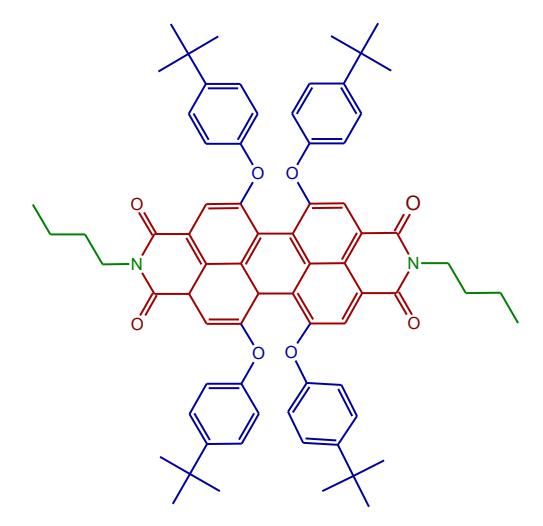
In this research, the fluorescence quantum yields of PDI7in two different solvents (ethanol and chloroform) were determined, employing three different methods. Molecular structure of this perylenediimide derivative is shown in Figure 1. Fluorescein, rhodamine 6G and sulforhodamine were used as standards. Furthermore, radiative and non-radiative fluorescence lifetimes of PDI7 in chloroform were determined and presented.