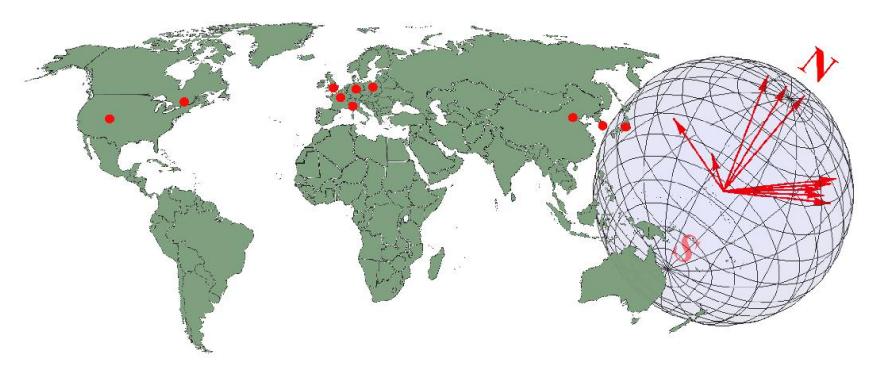
We present the data collected by the intercontinental atomic clock network. We show results of analysis of clocks readouts aimed on searches for dark-matter signatures.
Astrophysical observations indicate that the Universe contains five times more dark matter than standard matter, however its nature still remains an unsolved mystery. Dark matter candidates like topological defects and oscillating massive scalar fields can be searched for by a single optical atomic clock [1, 2]. Being the most precise scientific instrument, optical atomic clock makes great candidate for searches for physics beyond the standard model. Its two main components, ultra-stable optical cavity and cold atoms, have different susceptibilities to possible variations of the fine-structure constant, what makes an optical atomic clock sensitive to dark matter. This approach can be applied to many clocks, both distant and closely spaced, without the use of phase-noise compensated optical fibre links. It means that a global network can be established from currently operating optical atomic clocks since they are already collecting data needed for dark matter searches.
We describe the optical atomic clocks readouts analysis and provide a direct recipe for combining already existing optical atomic clocks to search for dark-matter signatures. Furthermore, we report new limits on both topological defects and oscillating massive scalar fields couplings to standard matter obtained from our transcontinental network. Our results exceed previously reported limits, showing that synchronization of the already existing optical atomic clocks is crucial for the future dark matter studies.