
Soil moisture is an important factor in the hydrological cycle controlled by precipitation, air temperature, evapotranspiration and infiltration into deeper layers [2]. Water content in soil is one of the main determinants of the vegetation conditions, because it determines the growth and productivity of the plant [1]. Soil moisture measurements are necessary in modelling and drought estimation. In situ point measurements have better accuracy, but poor spatial representation. Also, it is quite expensive. Remote sensing methods, like satellite information, could help to improve spatial resolution of soil moisture [3].
The goal of this research is to estimate relationship between satellite soil moisture and meteorological parameters in eastern Baltic Sea region (53–60°N and 20–30°E) covering the period from 1979 to 2016 warm season (April - October). Remote sensing soil moisture data were used from ESA Soil Moisture CCI Project soil moisture product created from merged active and passive products (water amount m3/m3) with 25 km spatial and daily temporal resolution. For meteorological conditions it was used minimum, maximum and daily mean air temperature and daily precipitation amount from E-OBS with 25 km spatial resolution.
It was found that highest air temperature and most precipitation is in July compared with other months in analyzed area. Meanwhile, soil moisture in July is the lowest (the average area of the whole area was 0.17 m3/m3). The highest moisture content in the soil is in April and October (0.21–0.22 m3/m3).
In different years, meteorological parameters can vary greatly in the same month. The most variegated values is in July (standard deviation for temperature reach 1.7 °C and for precipitation 41 mm.) Meanwhile, soil moisture varies the most in October (0.02 m3/m3).
Soil moisture is most strongly determined by the combination of air temperature and precipitation. The strongest correlation was found between daily precipitation and one day later soil moisture (1 day inertia) (correlation coefficient reach r=0.5)
However, the total amount of precipitation over long periods is also important for soil moisture. Analyzing sums of precipitation in last 2, 3, 5, 10 and 15 days found that the soil moisture is mostly determined by the amount of precipitation in the last 2–10 days (mostly 5 days).
Research showed that different parts of analyzed area have few relationship patters (Fig. 1). Precipitation and soil moisture relationship is stronger in northern and southern part (r=0.4–0.5), but in central part is more important air temperature (r=-0.4–-0.5), especially in the Middle Lithuania and Žemaičiai heights.
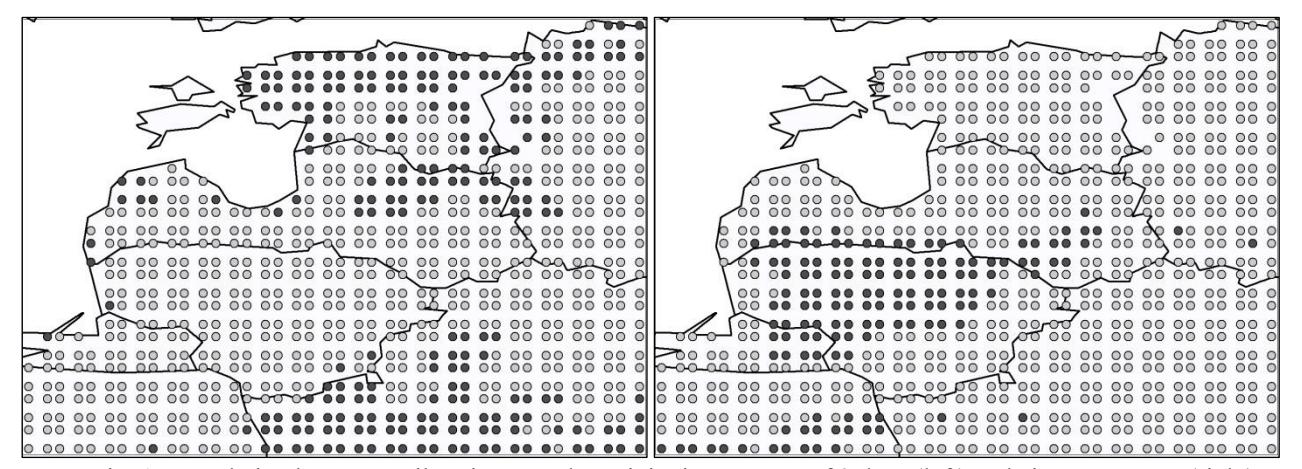
These results show that remote sensing soil moisture data has relationship with meteorological parameters. Relationship has lagging time until 10 days, so using meteorological forecast it is possible to predict soil moisture too.