
Neutrophils are immune cells which provide intracellular or extracellular capture of different particles and cells destroying them by oxygen-independent and oxygen-dependent enzyme mechanisms. Oxygen-dependent mechanisms include activation of myeloperoxidase (MPO), NADPH-oxidase, NO-synthase and generation the reactive oxygen, nitrogen and chlorine species (RONCS), in particularly, O2-, H2O2, OCl-, ONOO- and free-radical products. Intracellular destruction is associated with endocytosis. Extracellular destruction is due to neutrophil extracellular "traps" (NETs) formation from DNA strands with enzymes localized on them. Pathogen microorganisms as well as erythrocytes, platelets can be captured in these NETs [1,2]. It is assumed that RONCS released outside neutrophils can influence the cells on the principle of feedback and change their activity. Accumulation of NO2- in medium can occur due to processes not associated with neutrophils, but NO2- interactes with neutrophil products that leads to additional RONCS yield. The aim of the work was to investigate the effects of H2O2, OCl-, ONOO-, NO2- on neutrophil activity.
Neutrophils were isolated from donor blood by density gradient centrifugation. Cells were resuspended in Earle's medium at pH 7.3. The cell activity was assessed by chemiluminescent method under the action of fMLP (10 μM), PMA (8 μM) and during adhesion to glass. The cell structure was studied by nephelometry and light microscopy.
It was established that the kinetics of RONCS generation were changed as a result of the incubation of cells in the presence of NO2- (in a concentration of 0.02 to 1 mM), H2O2 (from 10 to 80 μM), ONOO- (7-12 μM), OCl- (5 μM). When cells were activated with fMLP or PMA, an increase in the ability of neutrophils to generate RONCS was revealed during the first minutes, then a decrease in the RONCS yield can be observed compared to cells incubated without adding extracellular RONCS. The cell ability to generate RONCS and secrete MPO in the extracellular medium upon activation during adhesion to glass increased in neutrophils incubated in the presence of NO2-, ONOO- and OCl- and decreased in neutrophils subjected to H2O2. Alteration of RONCS formation in neutrophils treated by combination of "NO2- + OCl-" was corresponded to the sum of the effects observed at separate action of NO2- and OCl-. The effects of combined action of "NO2- + H2O2", "NO2- + H2O2 + OCl-" on cell activity were not additive indicating the different mechanisms of RONCS action on neutrophils (fig.1).
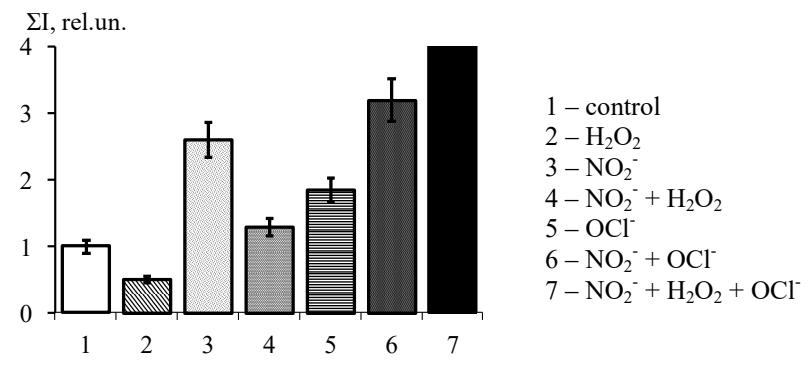
Colchicine is inhibitor of tubulin microtubule assembly required for intracellular transport of granules. Cytochalasin B a is blocker of the actin filament assembly. Inhibition of H2O2, ONOO- and lidocaine action was detected when neutrophils treated by cytochalasin B. Colchicine and lidocaine induced effects similar to the effect of H2O2 on neutrophil ability to generate RONCS. Previously, it was shown that exposure of neutrophils to H2O2 and ONOO- at low concentrations (1-100 μM) causes the increase of RONCS generation ability during phagocytosis of latex particles and the change of ability to secrete MPO [3,4]. The obtained data indicate the important role of cytoskeleton elements (microtubules and actin filaments) and enzymes which regulate granule movement in cells and secretion of oxygen-activating enzymes in realization of RONCS influence on neutrophils. The prolonged action of "NO2- + H2O2", ONOO-, PMA (but not H2O2) on neutrophils induced a change in cell sizes and formation of NETs, particularly at higher concentration of the substances. These effects can be blocked by the treatment of cells with cytochalasin B, lidocaine, inhibitors of oxygenases and NO-synthase.