Historically giant internodal cells of macroalgae Characeae have been extensively used as a convenient experimental system in plant electrophysiology, including ion channel research. Ion channel activity is crucial to maintenance of cell membrane electrochemical potential, osmoregulation, and morphogenesis. Ion channels also determine characteristics of action potentials, therefore research on a molecular level provides fundamental knowledge as well as insights into cellular plant signaling events [1].
Patch clamp technique provides an excellent means to research ion channel characteristics on a single channel level under near-physiological conditions. A microelectrode is pushed against a desirable membrane forming a high resistance (usually larger than 1 GΩ) seal. Currents passing through ion channels in the sealed area can be easily detected in high resolution. Thus patch clamp method enables analysis of electrical activity of ion channels that represents conformational changes of single molecules in real time [2].
It is difficult to patch plant plasma membrane due to the cell wall. This obstacle in Characeaen algae may be overcome by using cytoplasmic droplet technique – in this way an easy access to the vacuolar membrane (tonoplast) is provided. Characeaen cell is placed vertically in a solution approximately isotonic with the cell sap and "decapitated". The cell sap then flows out of the cell, in a bath solution spontaneously forming cytoplasmic droplets [3]. The spherical droplets consist of cytoplasm covered by the tonoplast.
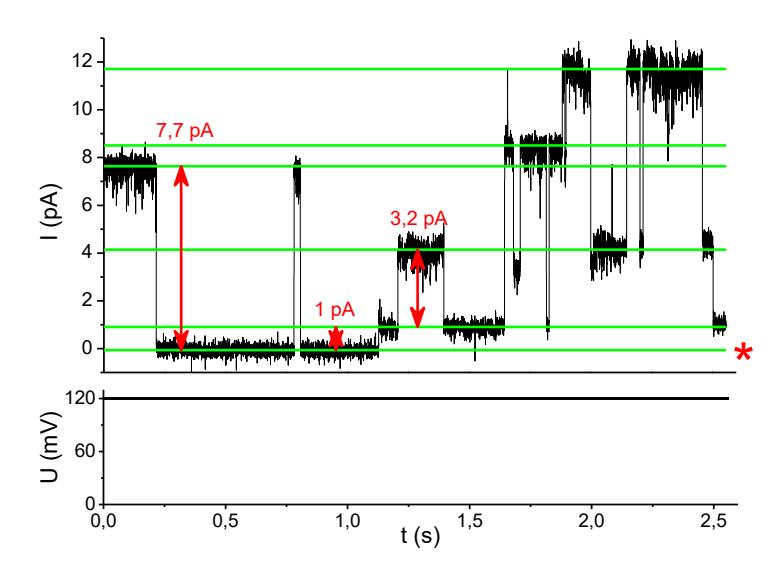
Our conducted experiments indicate at least three different ion channel populations in the tonoplast of a freshwater Characeaen algae Nitellopsis obtusa, easily distinguished by their conductances (Fig. 1) and densities in the membrane. In accordance with previous investigations [4], it is postulated that the highest conductance ion channels should be K+ channels while the middle conductance channels are responsible for Cl- transport.
The results suggest a complex ion channel system in the tonoplast of N. obtusa that may be employed to execute various physiological functions. Further investigations will shed more light on the properties of found ion channel populations and their possible roles in plant signaling.