
Ultrashort pulsed lasers are the first choice considering high quality, precise material processing. Picosecond (ps) laser pulses compared to nanosecond (ns) provide less heat affected zone and melt-free surface. Since most of the metals have picosecond range (copper ~10 ps [1]) electron-phonon thermalisation time, there is no need to use femtosecond (fs) laser pulses, which are more expensive than ps laser sources. So, ps lasers combine both precision and cost-efficiency.
The high throughput of laser ablation is a key factor for industry companies, especially for large area surface structuring [2]. This work was dedicated to the optimisation of ps laser ablation process taking into account many processing parameters: laser fluence, beam scanning speed, hatch distance (distance between lines which fill drawing) and pulse repetition rate.
It was shown that optimum fluence point where ablation rate is highest could be found by two methods. We have proved that material removal rate also depends on the lateral distance between pulses on the sample surface and has optimum value as well (Fig. 1).
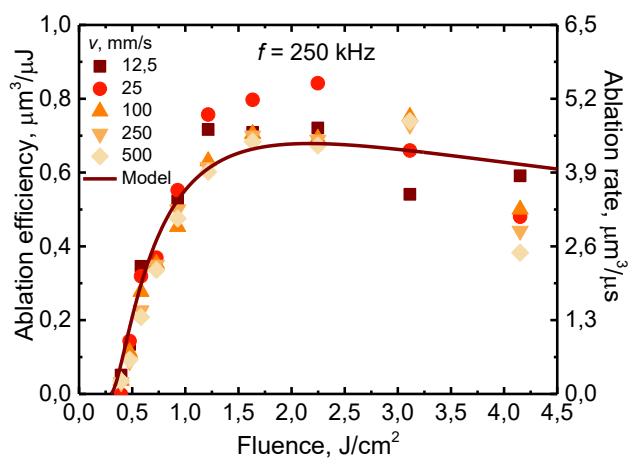
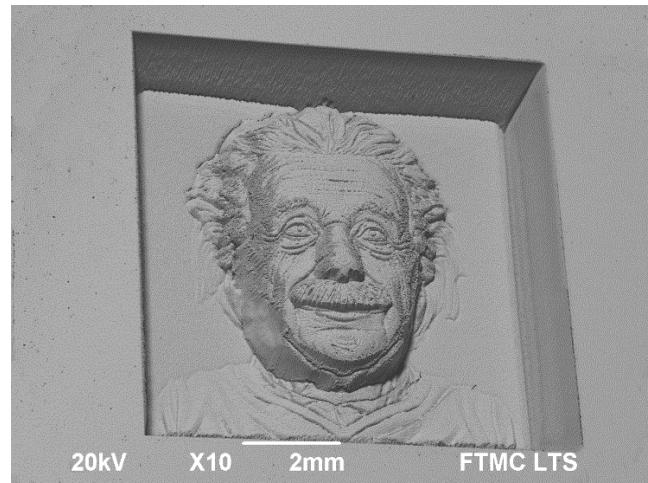
Furthermore, the processed surface had the highest quality at optimum processing parameters. That means that optimisation of ablation rate automatically optimises quality as well. This is very important for laser micromachining as a developing technology since both ablation rate and quality are the most crucial parameters. From experimental results of cavities ablation in copper, we have estimated laser processing parameters, which later were used for deep 3D engraving of Albert Einstein's bust (Fig. 2).