Terahertz (THz) frequency range lies between infrared and microwave frequencies, therefore both electronic and optical devices are being investigated as THz sources [1]. As scientific equipment, THz sources and systems are well developed and available in many research laboratories nowadays. However, the THz sources are still extremely complex, bulky and expensive for practical applications. Resonant-tunneling-diode (RTD) oscillators have reemerged in the recent years as a promising enabling technology of room-temperature THz and sub-THz sources for real-world applications [2,3]. RTD oscillators are operating close to 2 THz nowadays, they can emit up to ~0.5 mW of the output power at sub-THz frequencies and they could be as small as a fraction of mm2. Nevertheless, the output power and efficiency of RTD oscillators still need to be improved to meet the application requirements.
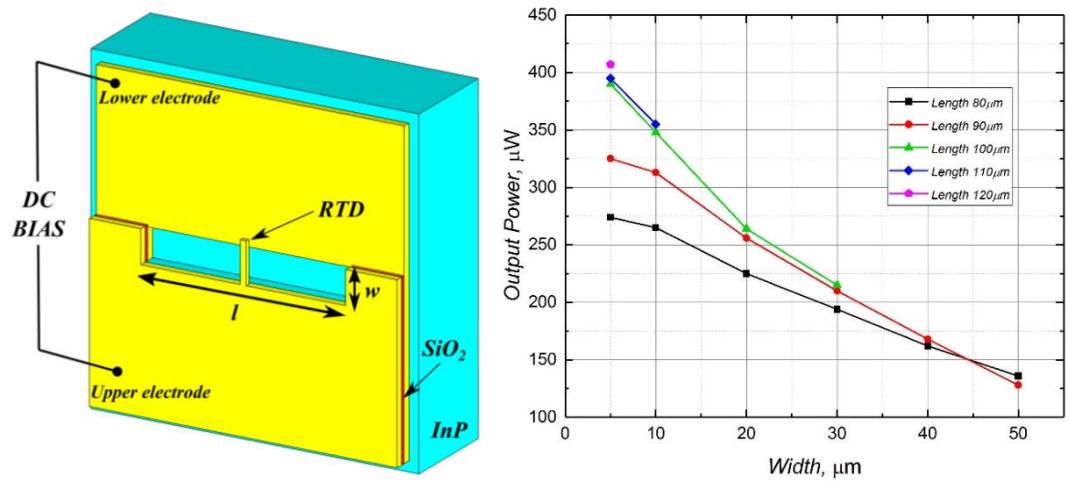
An RTD oscillator consists of a resonant antenna (usually, a slot one) integrated with an RTD. RTD provides gain in a wide frequency range and a resonant antenna is required to define the frequency of an oscillator, see schematic in Fig.1a. Since THz RTDs have relatively high capacitance (~10 fF/μm2), they have a strong impact on the resonant properties of the antenna. The oscillation frequency is determined by the interplay of the parameters of the RTD and of the antenna. E.g., due to high capacitance of the RTD, the slot antenna dimensions are usually much smaller than the radiation wavelength, therefore such antennas have a low radiation efficiency. Design of an efficient RTD oscillator is not a trivial task. One needs to find a proper balance between the properties of the antenna (e.g., by adjusting its dimensions) and RTD (its area, gain and other parameters). For example, the antenna radiation efficiency should be sufficiently high to make an efficient oscillator, but it should not be too high, otherwise the RTD gain will not be sufficient to compensate for the oscillator losses.
In this work, we optimize the parameters of slot antenna and RTD dimensions to maximize the oscillator output power. We have been considering slot antennas with the geometry typical for on-chip RTD oscillators, Fig.1a. Such oscillators are mounted on Si-lenses for collimation of the emitted radiation. We were varying the width and the length of the slot and adjusting the RTD area to match the target oscillation frequency, which was 300 GHz in this optimization run. The antenna characteristics have been calculated with the 3D electromagnetic simulator (CST STUDIO SUITE® 2018). Then they were combined with the RTD parameters, calculated with high-frequency RTD models developed by us in the past [4, 5]. In the work, we were using RTDs with the parameters similar to those used in the previous experimental works [3]. The optimization results indicate, that such RTD oscillators could provide an output power at the level of ~0.5 mW (see Fig.1b), which is a quite high value, considering a relatively small RTD area of ~1 μm2 and very low RTD current density of ~2.5 mA/μm2. The simulations also indicate that the DC to sub-THz conversion efficiency ($η$) could be at the level of ten or even tens percents, which is a surprisingly high level compared to $η$ at the level of few percents reported in the literature till now. The optimization results should be verified experimentally at a later stage.