
Heavy metals (HM) are among the most common environmental pollutants, and their occurrence in sediments derives from natural or anthropogenic sources. The geochemistry and magnetic susceptibility (MS) methods applied to beach sediments remains an underdeveloped field of research. Authors [1] pointed out that MS method can be very useful when targeting and selecting sampling sites for geochemical analyses. A good relationship between MS and HM were determined in a new studies related to HM pollution on the coast [2, 3, 4, 5]. As an example, authors [2] determined high positive correlation between higher in-situ MS values measured on the beach and higher Cu, Cr, Zn and Ni concentrations, the other authors [5] indicated that the MS values of the beach sand have a positive relationship with the higher concentrations of Fe, Mn, Cr, Ni, As and Pb.
The aim of our study was to investigate the possibilities of the indication of places possible polluted with the HMs using MS measurements along the southeastern Baltic Sea coast. The research was performed on the entire Curonian spit and mainland sea coast of Lithuania (136 km) in 2014. The beach along the southeastern Baltic Sea coast is backed by a vegetated foredune or moraine cliffs. The beach consists predominantly of quartzoze (enriched with heavy minerals) sand. A MS field survey was undertaken along the coast in the middle of the beach at equal distance every 1 km. In total, 135 surface sand samples were measured. To characterize the relative concentrations of heavy minerals (HMCs), a Bartington MS3 field scanning sensor was used for rapid and effective measurements of low-field volume MS. It is indicated that the in-situ MS values of $κ$<50 µSI defines the quartz-rich sands with low HMCs, and values higher than 50 µSI indicates the existence of higher surface HMCs, in other words the higher the MS value the higher possibility of determination the pollution with HM.
The MS values along the investigated sea coast ranges from 11.2 to 4977.9 µSI (Fig. 1). The mean MS value of entire coast is 170.9 µSI ($σ$ = 451.0 µSI). The mean MS value on mainland coast reaches 274.5 µSI ($σ$ = 158.0 µSI), and whereas on the Curonian spit it is 130.8 µSI ($σ$ = 517.4 µSI).
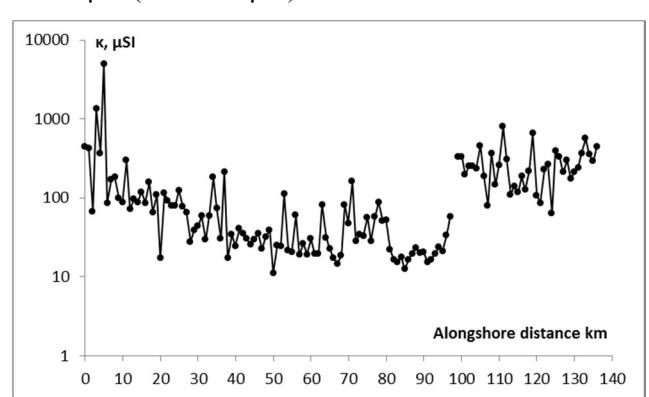
The greatest mid-beach MS values ($κ$>1000 µSI) occurs in the southern part of the Curonian spit. The greatest MS values on the mainland coast are less than measured on Curonian spit mid-beach. The greatest mid-beach MS values (500< $κ$<1000 µSI) on the mainland occurs near the Palanga, Šventoji seaside resorts and cliffs (Olando kepurė, Šaipiai).
These MS measurements illustrates that the main places with higher heavy mineral concentrations, which can be enriched with heavy metals, alongshore the southeastern Baltic Sea coast are located near the cliffs, on the beaches with high erosional processes and influenced by the intense human activities (beach nourishment, port jetties, groynes and etc.). For further investigation and data validation the geochemical analysis will be performed.