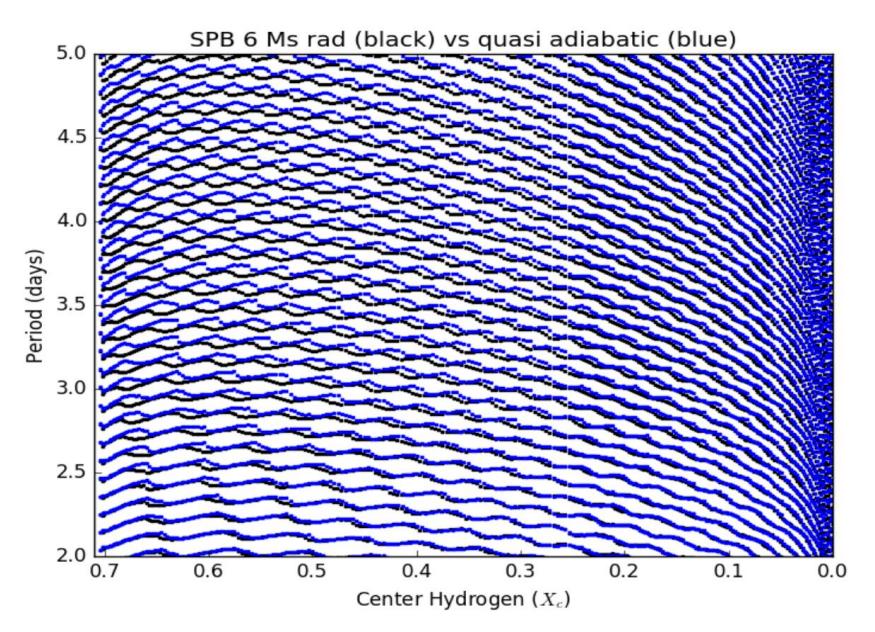
In this poster we present a theoretical and computational study for obtaining the oscillation dipole modes of pulsating main sequence B type stars (SPB and β Cep), constraining the behaviour of the temperature profile in the overshooting region. This is a critical but poorly-understood phenomenon which affect different parameters outside classical convection zones. Convective core overshooting is important because it extends the main-sequence lifetime of a star, thus modifying their evolution. We discuss some uncertainties in that region, concerning the quasi-adiabaticity in B stars. We focus on the g-mode behavior in that zones surrounding the convective core. For that we use the numerical codes MESA [1] and GYRE [2] for stellar evolution and oscillation respectively. We found obvious differences between the radiative and the adiabatic model, based on asteroseismological techniques.
The inclusion of quasi-adiabaticity in the overshooting region produces significant differences in the temperature gradients, properties of oscillation modes, period spacing and Brünt-Väisälä frequency. In the case of SPB, these differences are more significant for long periods and less evolved models. Recent studies can model perfectly the period spacing of KIC7760680 [3] for short-period modes, but observations and models show an anti-correlation towards the high order g-modes. One possible explanation is that was ignored the quasi-adiabaticity. The ongoing project includes revisiting KIC7760680 considering quasi-adiabaticity in overshooting region to confirm the hypothesis.