
Development of functional materials, such as polymeric films for wound healing, is an important area of investigation in Europe and beyond. In biomedical applications, the solutions for skin or mucous healing mostly depend on location and cause of injury. One of the specific wound type that attracted this investigation is corneal trauma [1-3].
Most of current solutions for closure of corneal defects, such as Tutoplast® (collagen-based product) and glycerine-preserved corneas, result in temporary poor vision, while ocular adhesives (fibrin-based and cyanoacrylate derivatives) are not suitable for closure of large defects.
Non-invasive protection of cornea by using biocompatible polymeric films is one of a modern solution for corneal injury repair, because it could form a mechanical barrier against external contamination and at the same time enhance cell growth. Moreover, specific physical-chemical parameters, such as appearance and transmittance, equilibrium water content, protein adsorption on a film surface and surface morphology, are highly important and applicable to this invention.
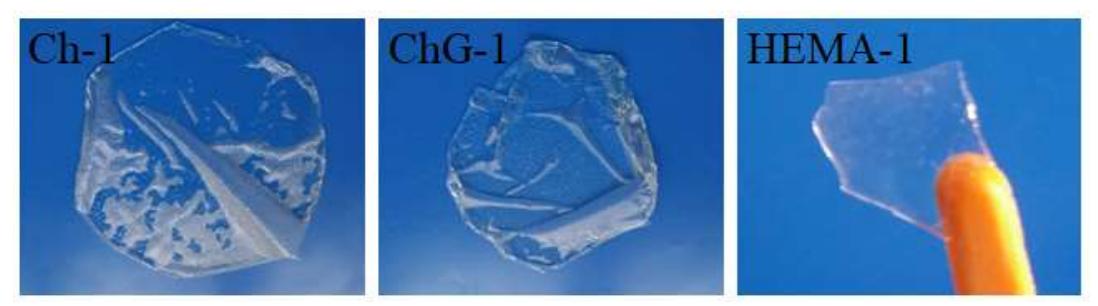
Chitosan-based, chitosan/gelatine-based and acrylate-based films for corneal repair applications were developed and examined. For the preparation of non-soluble chitosan film, prepared chitosan-based hydrogels were immersed in different solutions: (i) 2% NaOH in distilled water, (ii) 2% NaOH in 96% ethanol or (iii) 96% ethanol. For the preparation of crosslinked chitosan/gelatine film, prepared chitosan/gelatine hydrogel was immersed in 0.025% glutaraldehyde for 10, 20 and 30 min. For the preparation of acrylate-based film, 2.7 mL of hydroxyethyl methacrylate (HEMA) was mixed with 2 mL of distilled water and 10 μL of ethylene glycol dimethacrylate (EGDMA) and using diphenyl(2,4,6-trimethylbenzoyl)phosphine oxide as photoinitiator. Optical clarity was characterised by measuring the transmittance spectra using UV-vis spectrophotometer (600 nm). Transmittance of the selected samples was 0.112 ±0.002, 1.58 ± 0.042 and 0.013 ± 0.001 for chitosan-based film, immersed in 2% NaOH in 96% ethanol solution (Ch-1), chitosan/gelatine film, immersed in 0.025% glutaraldehyde solution for 10 min (ChG-1) and HEMA-based films (HEMA-1), respectively (Fig. 1). Thickness of the prepared samples was 0.797 ± 0.015 mm, 0.980 ± 0.02 mm and 0.205 ± 0.01 mm, respectively. Neutralisation of 1% chitosan hydrogel with 2% NaOH in 96% ethanol mixture contributed to the transparency of chitosan film for corneal trauma application (comparing with chitosan/gelatin crosslinked film), while transparency of acrylate-based film was almost 100%.
Current research shows that transparent chitosan-based films could be developed. However, further investigation of prepared films is required. Prepared polymer-based films are potential applicants for corneal trauma repair.