
Development of new functional materials and composites may accelerate the advancement of modern technology. The combination of textile fabrics and conducting polymers would open the path for advancement of wearable and flexible electronics, including various sensors [1], adaptive camouflage [2] and wearable displays [3]. The presented research was aimed to examine the combination of conducting polymer polyaniline and textile via electrochemical polymerization and investigate the prospects of such composites for applied use.
Polyester (PES) fabric PES/INOX (stainless steel/metal fibre) 20 tex blended yarn (80 : 20 %) known as S-shield PES [4], was produced by Schoeller GmbH & CoKG and supplied by Institute of Textile, Centre for Physical Sciences and Technology, Kaunas, Lithuania. Scanning electron microscopy image of S-Shield PES textile is given in figure 1. Alongside regular polyester yarns it contains electrically conducting stainless steel fibres which can be utilised as flexible electrodes within PES fabric matrix. This opens the prospects of both pre- and post-weaving textile surface modification via electrochemical methods and later employment of these methods to achieve greater functionality of textiles beyond traditional applications.
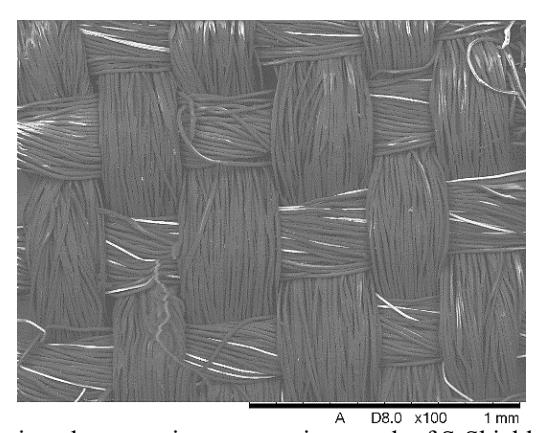
Deposition of conducting polymer polyaniline was performed electrochemically using cyclic voltammetry technique. The polymer was deposited from 0.5 M sulfuric acid solution containing 50 mM of the monomer. Experiments were carried out using conventional three-electrode cell where S-Shield PES served as the working electrode, Pt wire as counter electrode and Ag wire as reference electrode. Electrochemical deposition was performed by potential cycling between -0.3 V and 1.0 V for 10 cycles at 100 mV/s.
A green, well-adhered solid was observed to have formed on the surface of PES S-Shield textile electrode indicating a successful deposition of conducting polymer polyaniline. The modified textile was characterized by electrochemical and optical methods. It revealed that the polyaniline-modified textile exhibited reversible electrochemical and spectroelectrochemical character. This leads to a conclusion that textile and conducting polymer composites hold a great promise for future applications.