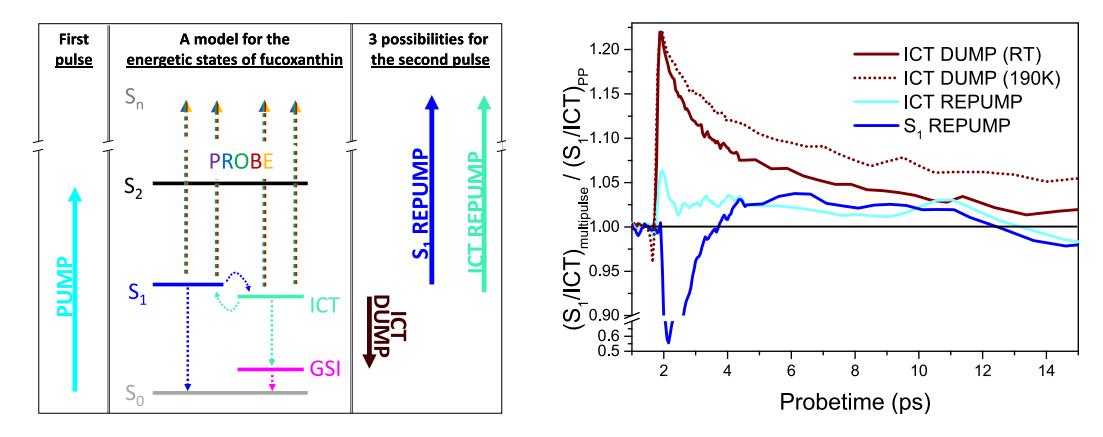
Without carotenoids as spectral sensitizers and photoprotectors, light harvesting systems of plants, alga, and other photosynthetic organisms would not survive in the light conditions in which we see them thrive. Primarily, these pigments efficiently transfer energy of absorbed light to nearby pigments, such as chlorophylls, in the first step of most photosynthetic processes. In some systems this efficiency is achieved through a frequently-debated S1/ICT state which recently has been revealed to be two coupled states. [1] The mystery is how these coupled states are involved in the energy transfer process and how to quantify their equilibration process. Multipulse transient absorption spectroscopy makes it possible to perturb the equilibrium by prematurely removing a population of one state in order to observe hidden and concomitant processes as well as energy transfer pathways. Featured here are pump-dump-probe studies on fucoxanthin in various environments and in Fucoxanthin Chlorophyll-a Protein (FCP) antenna, revealing their effects on equilibration dynamics between S1 and ICT states. Quantification of these processes as well as hints toward preferred donor state in FCP was revealed by global analyses and a Monte-Carlo approach to kinetic trace analysis.