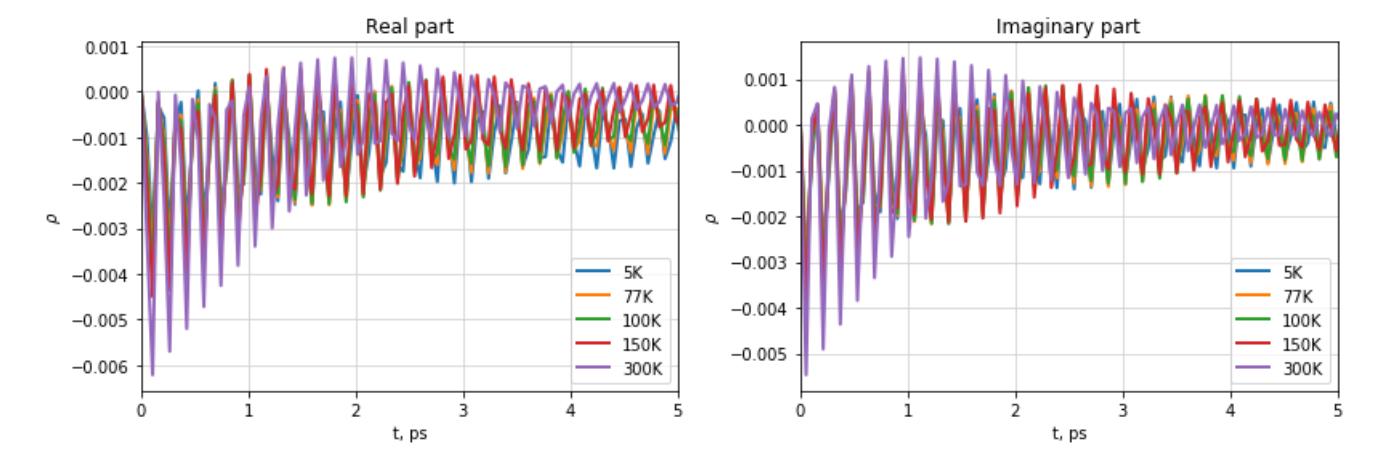
Quantum mechanics describes quantum static and dynamic effects in molecular systems. One of most popular used examples nowadays is light energy collection, exciton energy transfer between molecules, and charge separation effects [1, 2, 3]. But quantum mechanics application in condensed phase systems is very complicated problem. In recent decades there were new methods developed to calculate dynamic evoliution of quantum systems in thermal environment. But it is still hard to calculate numerically the excitation dynamics. Redfield relaxation equation is one of most used to describe nonequalibrium dynamics at arbitrary temperature.
In this work we take a look on to Redfield relaxation equation, we calculate density matrix elements time evoliution in excitonic system and density matrix elements dependance on temperature. At low temperature (5-100K) dependence on the temperature is weak, but at higher temperature (100-300K) differences between density matrix time evolutions are much higher. It is due to the thermal energy approaching the energy gap value between excitonic states $k_bT \rightarrow E_1 - E_0$. Coherences (Fig. 1) oscillate in broader intervals in high temperature and decay faster. Comparing amplitudes of coherences and populations it can be concluded that the coherences have a very small impact on excited state density matrix dynamics. Nonlinear dependence of relaxation coefficient values at low temperatures $k_bT < \gamma$ are do to transition from quantum environment, $\gamma > k_bT$, into classical $\gamma < k_bT$, where $\gamma$ - spectral density maximum.