Atmospheric aerosols can significantly influence local and global climate and their loadings have substantially increased since preindustrial times. The impact of particles depends on their chemical composition and physical properties (e.g. optics). The light scattering and the light absorption are two main interaction processes in the atmosphere between aerosol particles and solar radiation. Large uncertainties in estimating the aerosol radiative forcing [1] urge a better understanding of optical processes in the atmosphere.
We investigated aerosol optical properties in spring-summertime in Vilnius (urban background site). During experiments in May-June 2017, we deployed an Aerosol Chemical Speciation Monitor (ACSM), a 7-wavelength Aethalometer and an integrating Nephelometer (TSI). Ancillary measurements included the meteorological parameters (relative humidity, temperature, wind speed and solar radiation). We used Positive matrix factorization (PMF) of ACSM organic aerosol mass spectra to further characterize the sources of ambient organic aerosol (OA). Furthermore, absorption Ångström exponent (AAE) and scattering Ångström exponent (SAE) were calculated.
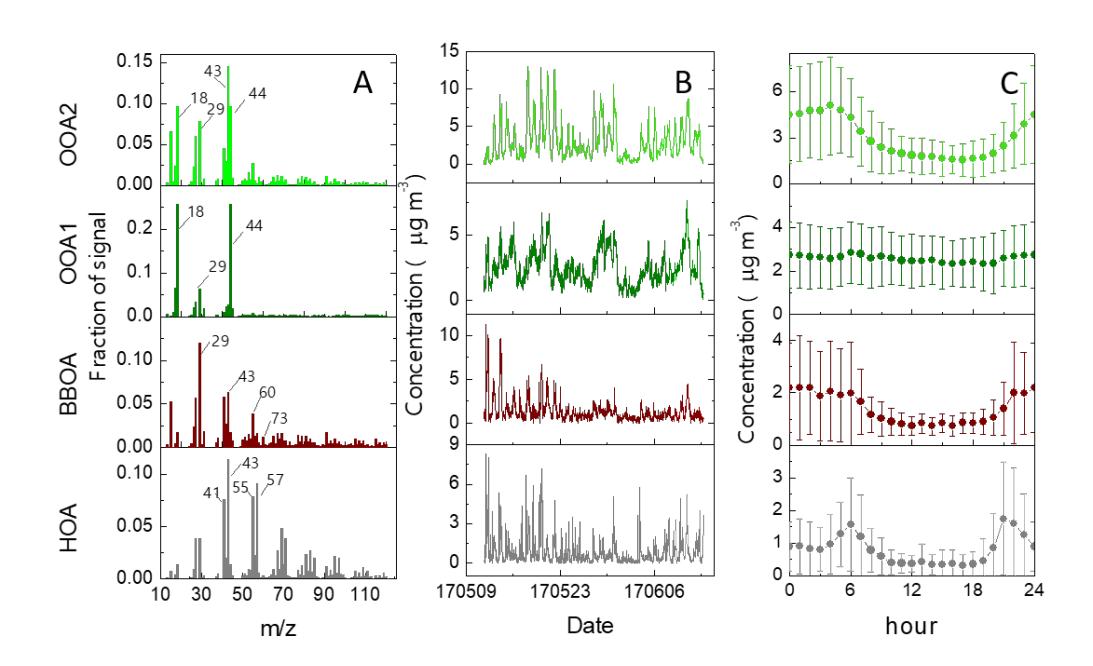
Non-refractory PM1 consisted of organics (84%, 6.35 µg/m3 with standard deviation (SD) of 4.00 µg/m3), nitrate (9%, 0.66 µg/m3 (SD=0.51 µg/m3)), ammonium (4%, 0.32 µg/m3 (SD=0.20 µg/m3)) and sulphate (3%, 0.20 µg/m3 (SD=0.12 µg/m3)). Four types of OA were observed: hydrocarbon-like organic aerosol (HOA), biomass burning organic aerosol (BBOA), more and less oxygenated organic aerosol (OOA1 and OOA2, respectively) (Fig. 1). At the beginning of the measuring campaign domestic heating was a reason of higher BBOA concentrations and its contribution to organics of the entire measuring campaign was 18%. As expected, main contributions to organics were OOA1 and OOA2 and reached 34% and 38%, respectively. A diurnal trend of HOA showed two diurnal peaks at rush hours (5-7 h and 19-21 h). The average value of AAE was 1.0 (with standard deviation of 0.2), indicating the dominance of fossil fuel versus biomass burning. SSA varied between 0.9 and 2.6 indicating a great variation among particles size distribution. To conclude, the undertaken investigation identified the main sources of OA and evaluated optical properties of aerosols. The results of this study can provide additional insights into forecasting the radiative forcing in local and global scale.