Linearly polarized beams are traditionally considered in nonlinear experiments of frequency conversion. However, more general case of elliptical polarization (which allows for polarization singularities) is presented in the literature rather poorly. Here we present experimental results of optical parametric amplification of seed beam, which polarization vary from linear through elliptical to circular. Both scalar and vector amplification geometries are considered. Additionally we show that spatial distribution of depleted pump beam depends on spatial distribution and polarization state of the seed.
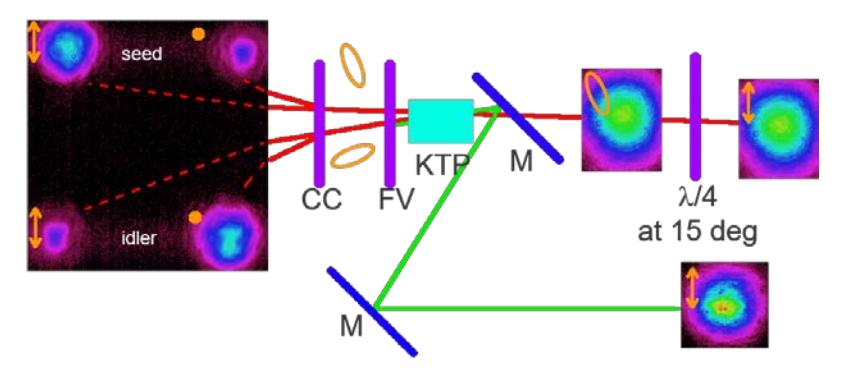
Fig. 1. demonstrates resulted intensity distributions of parametrically amplified 1064 nm elliptically polarized (orientation of ellipse $ψ$ = -75 deg, ellipticity $χ$ =15 deg) Gaussian seed beam and resulted 1064 nm idler beam. 532 nm vertically polarized Gaussian beam is used as a pump. As it can be inferred from resulting analyzed intensity pattern, polarization of the idler beam is orthogonal to that of the signal beam.
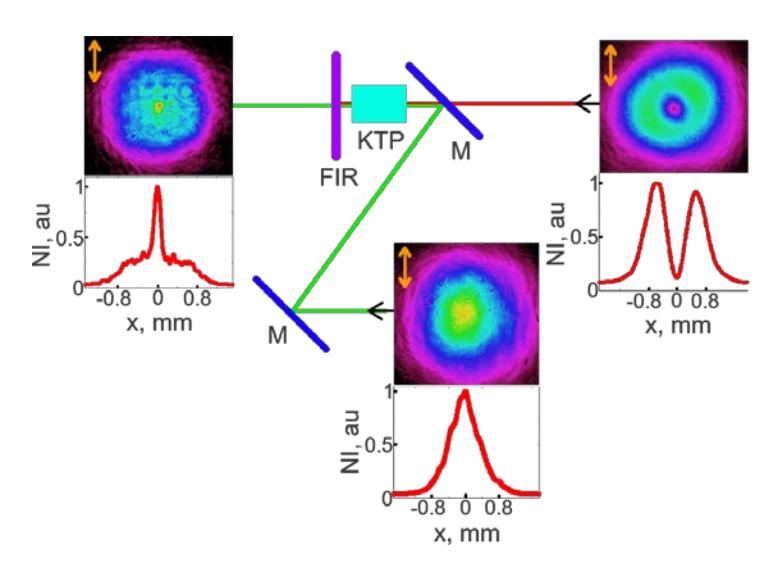
As it is seen from Fig. 2, spatial distribution of depleted pump beam resembles inverse of that of signal beam: while signal optical vortex beam has minimum intensity in the center, depleted pump beam has a needle-like pick of intensity in the center of a beam.