
Nowadays, great attention is paid to the search for new materials based on wide-gap oxides, as well as to studying their structure and properties for the purpose of application in various areas of the radioengineering, electronics and optoelectronics [1,2]. Even compounds based on such studied oxide as ZnO, obtained by ceramic technology, are not fully understood. The aim of this work is to study the electrical properties of ZnO-based ceramics when they are doped with iron using various types of $Fe_xO_y$ iron oxide alloying agents.
Samples based on ZnO prepared by the two-stage synthesis method were obtained by conventional ceramic technology. ZnO and $Fe_xO_y$ (FeO, $Fe_2O_3$, $Fe_3O_4$) powders were used as initial components. In the ceramics studied, we used the stoichiometric relation $(Fe_xO_y)_{10}(ZnO)_{90}$, where the mass of the iron oxide powders corresponded to 10 wt. %.
Electronic transport properties of ceramics in a magnetic field were studied by measurements of electrical conductivity and Hall effect that allowed to evaluated concentrations and Hall mobility of charge carriers. The character of temperature and field dependences pointed to strong inhomogeneity of the ceramics and large-scale potential fluctuations contribution to charge transfer [3-5].
The decrease in the concentration and change of temperature slop of n(T) (Fig.1a) indicated that main charge carriers in doped samples were originated from the deeper donor level than in non-doped ZnO.
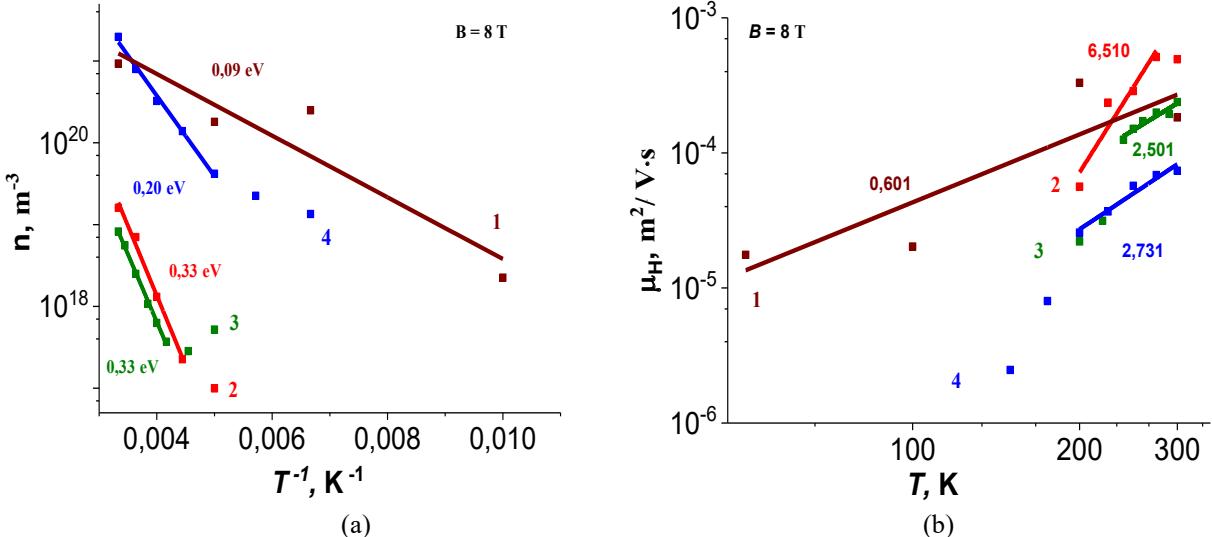
The Hall mobility $\mu_H(T)$ in doped ceramics (Fig. 1b) exponentially rises with temperature. The slope of $\mu_H(T)$ in logarithmic coordinates (Fig. 1b) rises with the increase of inhomogeneity. These observations indicate a power-law character of the Hall mobility temperature dependence typical for stronglyinhomogeneous materials [3].