
Skin is a barrier that protects organism from external factors/pathogens and prevents water loss. Various skin properties depend on the humidity of external environment. Knowledge of how humidity affects nanomechanical properties of the skin could be of great interest to pharmacy, medicine and cosmetology. The aim of this project is to develop a protocol for the use of atomic force microscopy (AFM) in a personalized health care system.
In literature there are several approaches to describe the use of unique technique as AFM either for the structural changes or for skin disease detection [1]. Previous studies characterizing the mechanics of stratum corneum have used macroscopic testing equipment designed for homogenous materials. Such measurements ignore the tissue's rich topography and heterogeneous structure, and cannot describe the underlying mechanistic process of tissue failure. It was already shown that skin tissue is highly dependable on ambient humidity to which samples are equilibrated [2].
In this work, AFM was used to investigate the changes in topography and elasticity of the dermatomed porcine ear skin due to different water activity ($a_w$) in ambient environment. Water activity is the partial vapor pressure of water in a substance divided by the standard state partial vapor pressure of water. In the other words, $a_w$ is the indicator of water capacity in the sample of interest. Nanomechanical and viscoelastic properties of the superficial skin layer, stratum corneum, may vary with the water content. And the response to water loss may indicate the state of skin – healthy intact or damaged (either unhealthy or treated, scarred) skin tissue.
The frozen samples of dermatomed porcine ear (~500 μm in the thickness) were thawed and incubated for 24 hours in three solutions with different water activity, $a_w$: phosphate buffer (PBS) pH 7,4, $a_w$=0,992; phosphate buffer/propylene glycol (PBS/PG) 8/2, $a_w$=0,936; phosphate buffer/polyethylene glycol 1500 (PBS/PEG1500) 55/45, $a_w$=0,946.
After incubation, surface topography maps (Fig. 1, A) and force-distance curves (Fig. 1, B) of samples were obtained either in the plain PBS or in the solution of interest. Mean elastic (Young's) moduli of the samples was calculated from force curves according Hertz model (spherical indenter):
$$F = \frac{4}{3} \frac{E}{(1-\nu^2)} \sqrt{R} \delta^{3/2} \tag{Eq. 1}$$where F = force (from force curve), E = Young's modulus (fit parameter), $\nu$ = Poisson's ratio (sample dependent, typically 0.2 - 0.5), R = radius of the indenter (tip), $\delta$ = indentation.
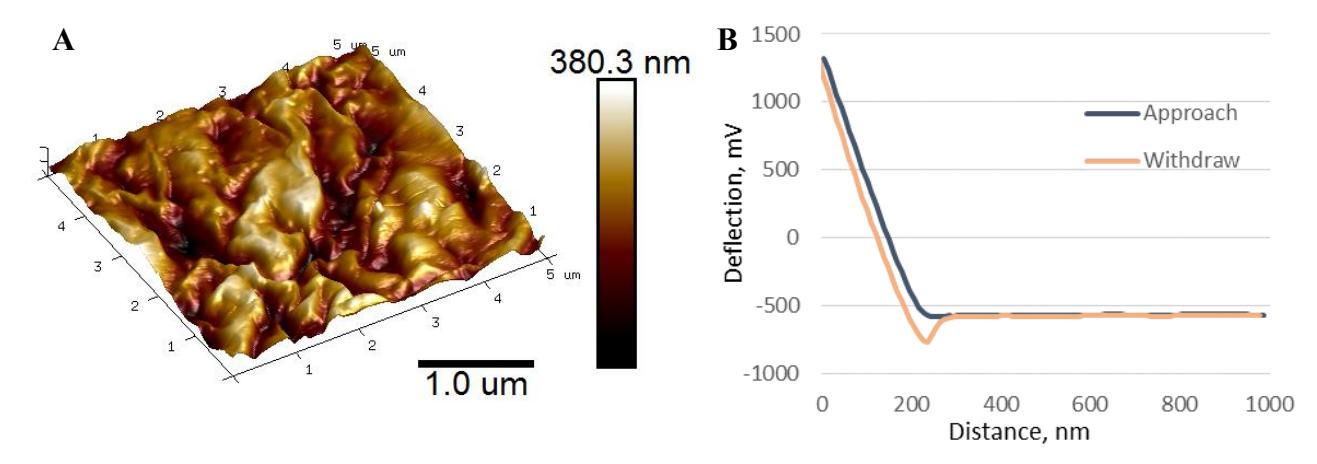
Calculated elastic moduli for skin samples, incubated in PBS, PBS/PG and PBS/PEG1500 were 1,23±0,86 MPa, 1.75±0,82 MPa and 1,81±0,70 MPa, respectively. Results show that even small changes in water activity significantly affect stiffness of the skin – with decreasing water activity elastic modulus increases, i.e., skin becomes stiffer.