Femtosecond 3D nanolithography, commonly referred as direct laser writing, is keeping the pace by its' rapid development employing nonlinear light-matter interaction and in recent years has got significantly closer from its academical origins to industrial applications. It has been demonstrated that femtosecond 3D nanolithography is a suitable technique for 3D fabrication of biodegradable tissue scaffolds, chip-scale interconnects, lab-on-a-chip microdevices and other functional elements as micro-optical elements urging the technique's lab-to-fab transfer [1].
Functional 3D printed micro-optics can be used in various applications [2], yet further spread is limited by the uncertainty of optical resiliency (i.e. degradation in intense light) of available photopolymers. In this work we have chosen five variant polymers differing in their origin (commercial and experimental), composition (purely organic and hybrid organic-inorganic) and performed quantitative study of their optical resiliency. Tested materials include common in lithography SU8, OrmoClear oriented to optical applications, Ember PR48 used in stereolithography, SZ2080 hybrid organic-inorganic material [3] suitable for diverse use, which was also tested both, photosensitized and pure.
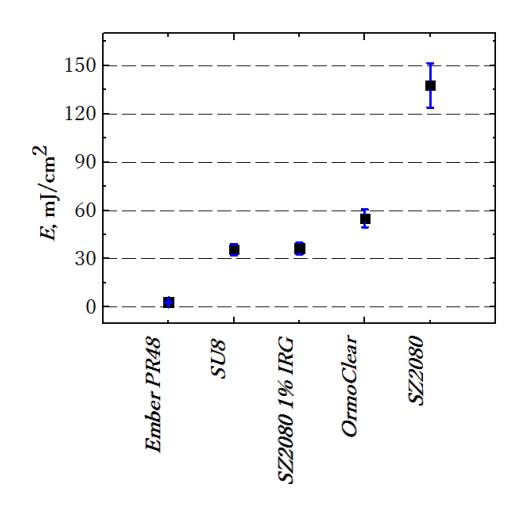
Our femtosecond 3D nanolithography produced microstructures research for optical damage threshold comparison was performed for volume micro-optical elements as for this day closest experiments are performed only with photopolymer thin-films [4]. Tests were performed using S-on-1 laser induced damage threshold (LIDT) evaluation method. It relies on statistical data using linear approximation of the characteristic damage curve for LIDT determination. Microstructures were irradiated for 60 s with 1030 nm, 100 kHz, 300 fs laser pulses using $f$ = 10cm focusing lens considering that experienced fatigue would allow finding close to practical daily use polymer LIDT value. Carried out optical damage threshold measurements suggest, that photoinitiator presence in the photopolymer plays crucial role for its' optical resilience. Even after standard error evaluation [5], SZ2080 without photoinitiator LIDT exceeded all other materials by several times [Fig. 1].