
Transient current technique (TCT) is based on the analysis of the current pulse durations and shapes which arise from the non-equilibrium carrier capture and drift processes within the electric field region inside the material. Considerations of TCT, based on Shockley-Ramo theorem (SRT) model, are widely applied for direct evaluation of the excess carrier drift mobility [1].
In this work, carrier drift mobility in the bifluorene BF-10 organic compound layers of 1 μm thickness have been investigated by recording of current transients using parallel (with the same oriented electric field and impinging laser beam) profiling regime and optical injection of carrier domains. The capacitor type device structures were formed by deploying indium-tin oxide (ITO) electrodes, transparent for excitation light. Profiling of the capacitor type organic device has been performed by varying applied voltage in the range from 10 to 60 V. Ultraviolet (354 nm) laser pulses of 400 ps duration were used to inject excess carrier sheets within inter-electrode gap.
Changing polarity of voltage on electrodes enabled us to separate the packet of drifting carriers, - either holes or electrons (Fig. 1). The initial component of a current transient is ascribed to a bipolar drift (Fig. 1b). Here, a sub-domain of the excess spatially separated carriers, which polarity is relevant to be attracted to a front electrode, rapidly moves to this electrode and induces charge on electrodes, according to SRT. This induced charge modifies a drift of the second sub-domain by slowing it. While the current variations in the tail stage of a transient are associated with the monopolar drift of a sub-domain of carriers which are attracted to a rear electrode (Fig. 1a). The current, determined by this monopolar drift of a slow sub-domain, decreases due to carrier capture to traps, and this carrier density reduction can be partially compensated by field enhanced re-emission (Poole-Frenkel effect) of trapped carriers. Nevertheless, current pulse ends when the slow domain reaches a rear electrode, and this instant can be clarified from the rear kink within current variation curve (Fig. 1a). Both components of a current pulse, associated with the hole and electron drift, have been clearly observed for the bias voltage values close to 60 V, as illustrated in Fig. 1.
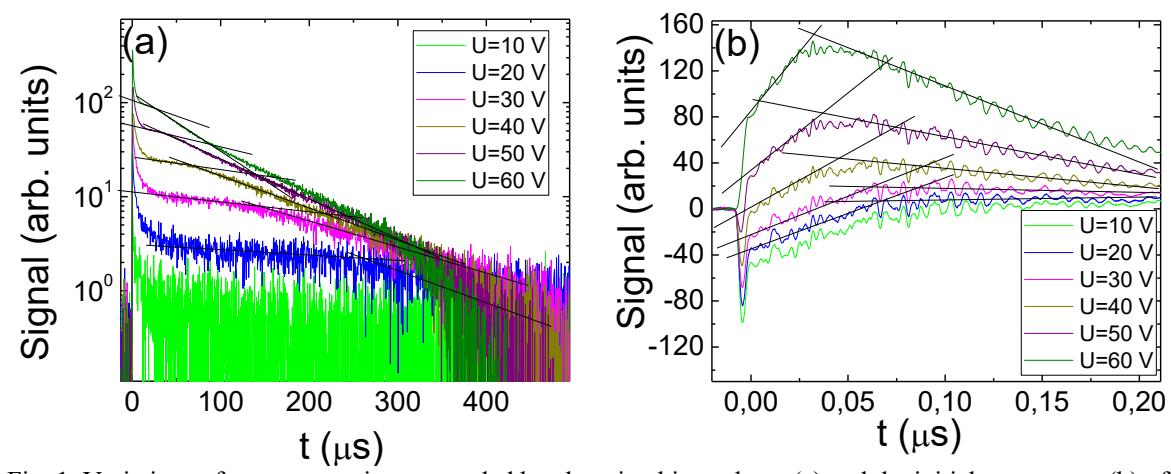
The characteristic transit times of holes and electrons have been extracted from these current transients. The acting fields can be estimated from simulations of these transients using the SRT model. Then, the drift mobility and carrier lifetime parameters have been evaluated. Field dependent variations of these parameters in BF-10 capacitor-type structure will be discussed.