
The 808 nm excited lanthanide doped upconverting nanoparticles (UCNPs) have received much attention in recent years due to minimized heating effect, improved tissue penetrability and lower water absorption if compared to the conventional excitation with 980 nm laser. These UCNPs are more appropriate for in vitro/in vivo biomedical diagnostic and theranostic applications [1]. Nd3+ ions are considered as good energy donor candidate because of its high absorption cross-section around 800 nm which is about one order of magnitude larger than its Yb3+ counterpart at ca. 980 nm. Further energy transfer to bridging Yb3+ ions with transfer to energy acceptor-activator ions (Er3+, Tm3+, Ho3+, Pr3+) [2] would be the cause of emission in visible (VIS) and near-infrared (NIR) regions.
In the present study single phase hexagonal NaGdF4:Nd3+ (0-10%), Yb3+ (20%), Er3+ (2%) and NaGdF4:Nd3+ (0-40%), Yb3+ (20%) nanoparticles with size range of 36-58 nm were synthesized by the thermal decomposition of trifluoroacetates method. Typical emission lines originating from the intraconfigurational transitions of Yb3+, Er3+ and Nd3+ ions were observed in VIS and NIR regions. The acquired data showed that the ratio of integrated intensity of green and red emission bands of Er3+ ions decrease if doping concentration of Nd3+ ions increases.
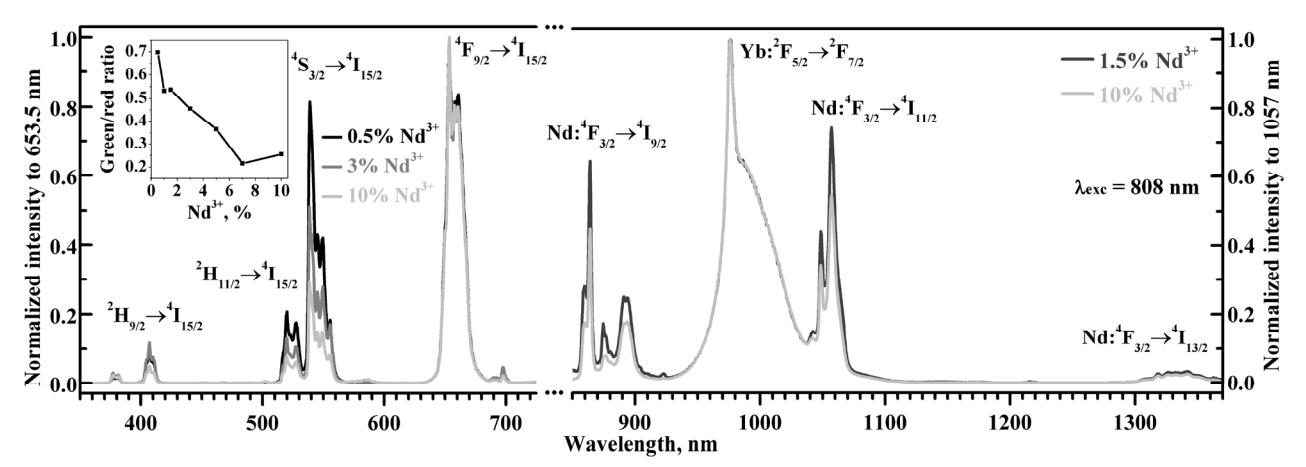
A typical optical limitation of lanthanide doped nanostructures is emission quenching which occurs as a result of cross-relaxations between dopant ions leading to energy loss through non-radiative processes [3]. Unfortunately, the literature on the $Nd^{3+} \rightarrow Yb^{3+}$ energy transfer and the optimal $Nd^{3+}$ and $Yb^{3+}$ concentrations is rather scarce. Therefore, the aim of this work is to investigate the $Nd^{3+} \rightarrow Yb^{3+}$ energy transfer in single phase NaGdF4 hexagonal nanoparticles with particular focus on finding optimal concentration of these ions when the energy transfer is the strongest and cross-relaxation processes are the weakest. The energy transfer and cross-relaxation processes were investigated by exciting the synthesized nanoparticles with 808 nm laser radiation and measuring their room temperature emission spectra in the VIS and NIR range. This data was supported by recording the photoluminescence decay curves for Nd3+, Yb3+, and Er3+ emission and calculating their emission lifetime values. Furthermore, the temperature dependent emission spectra and photoluminescence decay curves in the range of 77–500 K were also recorded and will be discussed in great detail.