BLUE-LIGHT-EMITTING DERIVATIVES OF BENZOPHENONE AS ELECTROACTIVE MATERIALS
Rasa Keruckienė1, Liveta Lapienytė1, Juozas Vidas Gražulevičius1
1 Department of Polymer Chemistry and Technology, Kaunas University of Technology, Lithuania
Organic luminescent materials have attracted increasing attention for their potential applications in the fields of displays and sensors [1]. To achieve better performance, it is of great importance to have a deep understanding of the inherent light-emitting process and internal mechanism. The employment of thermally activated delayed fluorescence (TADF) in the active layers of organic light emitting diodes has been stated to be very efficient [2]. TADF materials can achieve 100 % of use of excitons through reverse intersystem crossing because of their low energy gap between the lowest singlet excited state S1 and triplet excited state T1 [3]. The strategy to achieve such characteristics is to employ both donor and acceptor moieties in a single molecular structure.
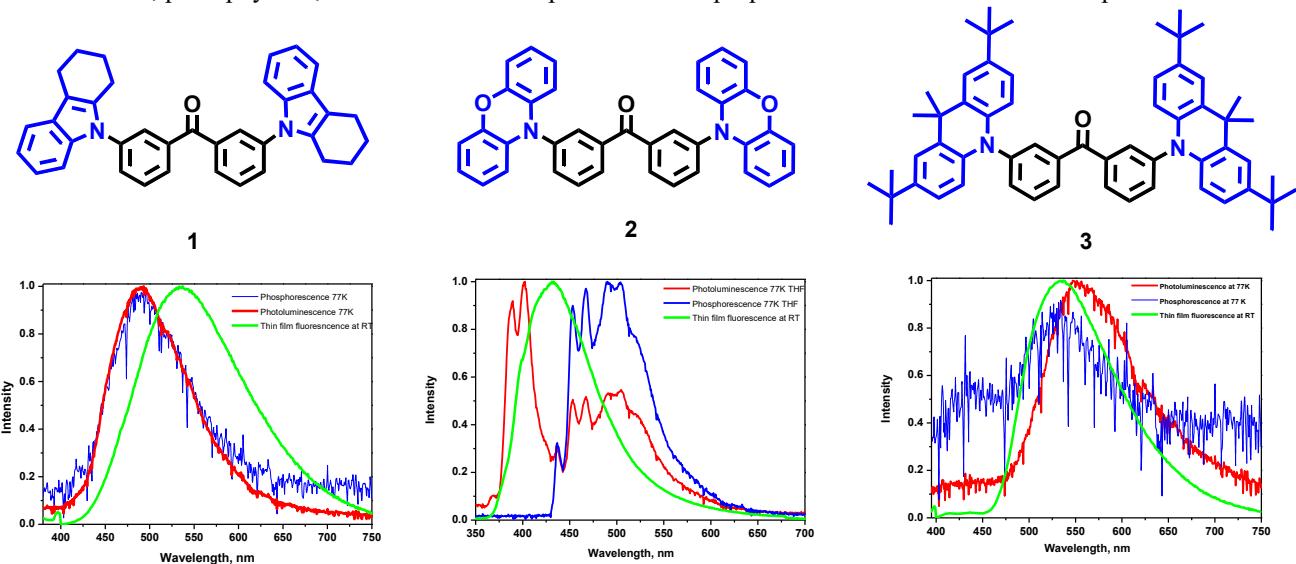
In this work, we present benzophenone-based emitters bearing donor-acceptor-donor electronic structure. Benzophenone is known to be a stable acceptor [4]. The donor moieties such as tetrahydrocarbazole, phenoxazine and dihydrodimethyacridine were chosen due to their favourable HOMO orbitals delocalization and electron donating ability [5]. The derivatives were obtained by two-step synthesis procedure. The first step was bromination of the benzophenone and the second step was Pd-catalyzed Buchwald-Hartwig coupling of 3, 3'-dibromobenzophenone with corresponding donor fragments [6].
Thermal, photophysical, electrochemical and photoelectrical properties of the materials will be reported.
Fig. 1. The structures of the electroactive compounds and their photoluminescence and phosphorescence spectra.
Acknowledgments: This research was funded by the European Social Fund according to the activity 'Improvement of researchers' qualification by implementing world-class R&D projects' of Measure No. 09.3.3-LMT-K-712.
[1] H. Sasabe, J. Kido, Multifunctional Materials in High-Performance OLEDs: Challenges for Solid-State Lighting, Chemistry of Materials23, 621–630 (2011).
[2] S-Y. Lee, T. Yasuda, Y-S. Yang, Q. Zhang, Ch.Adachi, Luminous Butterflies: Efficient Exciton Harvesting by Benzophenone Derivatives for Full-Color Delayed Fluorescence OLEDs, Angewandte Chemie126, 6520–6524 (2014).
[3] T. Komino, H. Nomura, T. Koyanagi and C. Adachi, Suppression of Efficiency Roll-Off Characteristics in Thermally Activated Delayed Fluorescence Based Organic Light-Emitting Diodes Using Randomly Oriented Host Molecules, Chemistry of Materials25, 3038–3047 (2013).
[4] S. Aloise, C. Ruckebusch, L. Blanchet, J. Rhaut, G. Buntinx, J.-P. Huvenne, The Benzophenone S1(η,π*) → T1(η,π*) States Intersystem Crossing Reinvestigated by Ultrafast Absorption Spectroscopy and Multivariate Curve Resolution, Journal of Physical Chemistry A112, 224–231 (2008).
[5] R. Komatsu, H. Sasabe, Y. Seino, K. Nakao and J. Kido, Light-blue thermally activated delayed fluorescent emitters realizing a high external quantum efficiency of 25% and unprecedented low drive voltages in OLEDs, Journal of Materials Chemistry C4, 2274–2278 (2016).
[6] G. D. Vo, J. F. Hartwig, Palladium-Catalyzed Coupling of Ammonia with Aryl Chlorides, Bromides, Iodides, and Sulfonates: A General Method for the Preparation of Primary Arylamines, Journal of American Chemical Society131, 11049–11061 (2009).