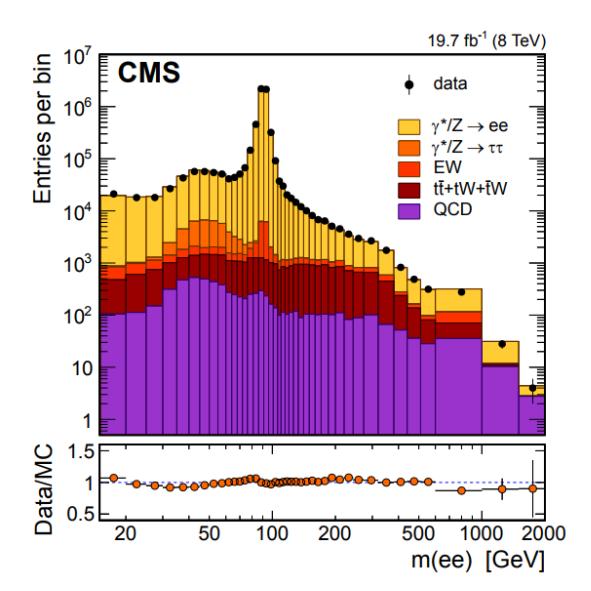
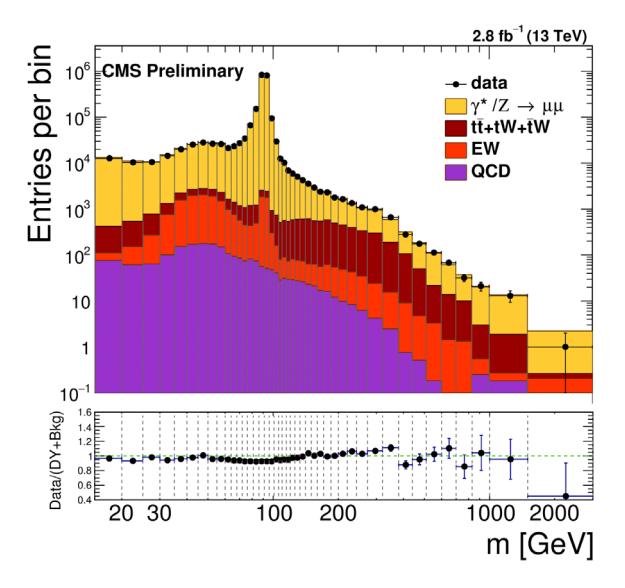
Interactions between proton component parts, named "partons" (quarks and gluons), might occur in high-energy proton-proton collisions. The inner structure of the proton is described using parton distribution functions (PDFs). The probabilities of parton-parton interactions depend on the the types of partons and the amount of energy they have. Therefore, calculations of probabilities of rare events are quite dependent on the precision of the PDFs.
Drell-Yan process is a quark-antiquark annihilation resulting in a lepton-antilepton pair. Theoretical predictions for the differential cross section of the Drell-Yan process are available at next-to-next-to-leading order (NNLO) in perturbative quantum chromodynamics (QCD). The experimental analysis of this process allows to constrain parton distribution functions. Precise measurements of the standard model processes including the differential Drell-Yan cross section allow to test perturbative QCD and the theoretical predictions of higher-order corrections [1].
The measurements of the differential Drell-Yan cross section are carried out by different experiments at the Large Hadron Collider (LHC) at CERN. They are done at various proton-proton collision energies [1-4]. Some uncertainties of the measurement are related to the response of the detector. A significant contribution to the measurement uncertainty of the Drell-Yan process originates from simulation of distinct background processes. In order to reduce these uncertainties, the number of background events is estimated using data-driven methods. A background-dominated control region is defined, and the number of background events from this region is transformed into the number of background events in the signal region. Background processes which can independently produce different or same type of leptons are estimated using the eμ method. Other processes, in which jets (streams of particles) might be produced, are estimated using the fake rate method. These two methods and their accuracy will be discussed during the presentation in the context of the measurement at CMS.
Study of the differential Drell-Yan cross section at the CMS experiment is supported by the Lithuanian Academy of Sciences.