
In recent years terahertz (THz) time-domain (TDS) spectroscopy systems have become more accomplished and found its application in various fields. One of the main component of such systems is a THz pulse emitter which could be made of various semiconductors, their compounds and nanostructures. In order to create more effective THz emitter it is important to understand the physical mechanisms responsible for THz generation. For this purpose a lot of modified THz TDS methods were created. One of the modification is double-pump-pulse THz emission (DPP) method that was first mentioned in 2002 by Tanouchi el al [1]. The main idea of this method is to use two excitation pulses instead of usually used one. In this work we have analysed standard DPP method, relieved its drawbacks and suggested a novel modification of DPP (MDPP) measurements. We use MDPP method for the investigation of THz emission efficiency dynamics in p-type InAs that is best-known THz surface emitter.
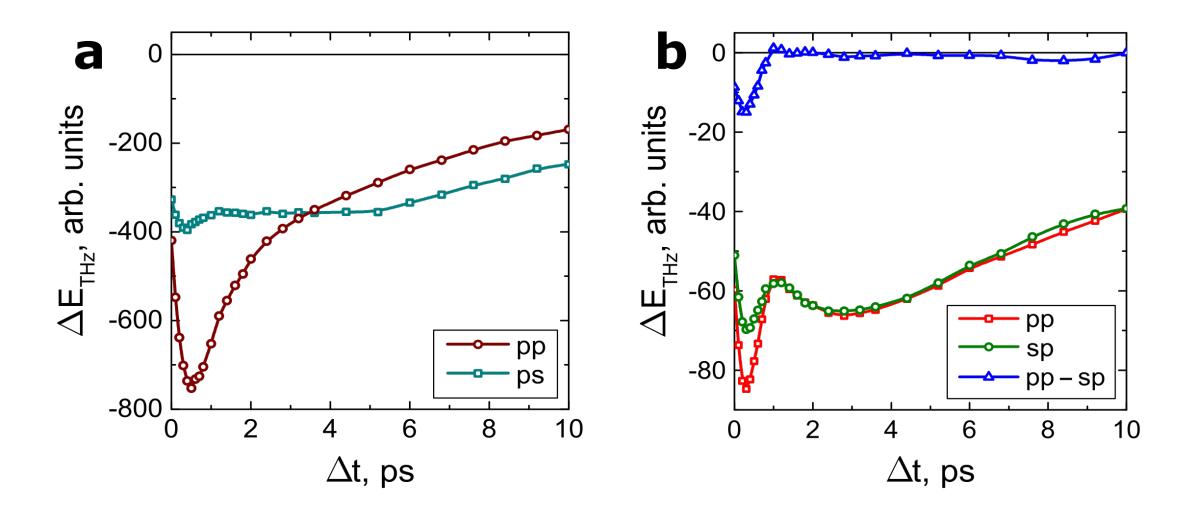
In MDPP measurements the First pulse creates photocarriers with the frequency of mechanical chopper and affects the THz generation process initiated by the Second pulse. In the other words it is possible to measure an indirectly modulated THz pulse which reflects the difference in THz emission initiated by the Second pulse due to the influence of the First pulse. In Fig. 1 the amplitude of indirectly modulated THz pulse dependence on a time delay between the First and the Second pulses is shown. It is obvious that THz generation properties strongly depend on the polarization of the Second pulse (Fig. 1a). The polarization of the First pulse does not affect THz generation process so heavily, nevertheless small difference under s and p polarized excitation could be seen (Fig. 1b). We have found out that the First pulse builds electric fields near the surface, while the Second pulse creates THz radiating electric dipoles upon the influence of these electric fields. In addition, we have noticed that the polarization of the optical excitation pulses could be used to change the orientation of the mentioned electric fields and dipoles. Thus it is possible to observe the influence of variously oriented electric fields upon the formation of electric dipoles and their ability to emit THz pulses. Moreover, the MDPP method becomes a tool to investigate the dynamics of the electric fields created after photoexcitation.
Our suggested method is shown to be a precise and sensitive way to study electric fields in semiconductors and electric properties of photocarriers after photoexcitation. Received results would lead to a better understanding of THz generation process that could help to create more efficient THz emitters. Furthermore, the time resolution of MDPP method is a few hundreds of femtoseconds therefore it is a promising tool to investigate rapid processes, such as the ballistic electron transport dynamics.