
The coastal zone is a dynamical system which is constantly changing. This system is quite sensitive to changes of extreme hydrodynamical processes but even more sensitive to human activity. The coastal zone of Palanga was distinguished by wide beach with light-yellow fine grained quartz sand bordered by foredunes. An increase in erosion processes from the end of the 20th century determined a retreat of shoreline and coastal zone sediment loss. These problems led to a decision to nourish the beach. The beach nourishment is a modern, effective and ecological method to protect the coastal zone from erosion. The Palanga beach was nourished with 574 648 m³ of sand during 2006-2012 [1].
The aim of this study was to analyse the changes in sediment budget in Palanga recreational zone during 1975-2015. To achieve the aim, cross-shore levelling in 9 profile were carry out along a 2.5 km long stretch from Rąžės stream to Birutės hill. Output results such as shoreline displacement, beach width, annual and total subaerial beach volume were calculated on the bases of levelling of cross-shore profile data [2].
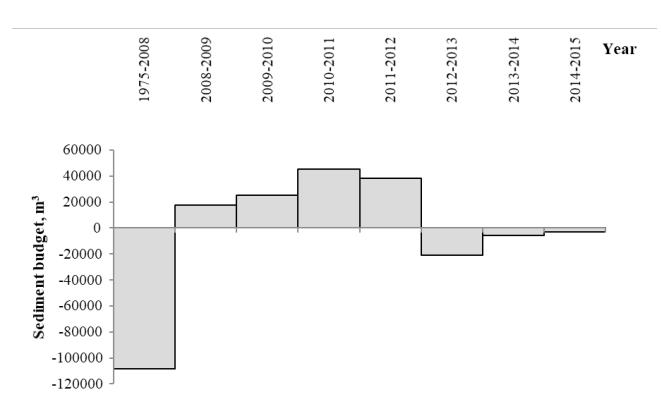
The results revealed that the beach in Palanga recreational coastal zone narrowed from 80 to 20 m with sediment loss amounted on 108 593 m³ during 1975 – 2008 (Fig. 1). During the subsequent period of 2008-2012 the average width of the beach expanded by 80 m as a result of the beach nourishment.
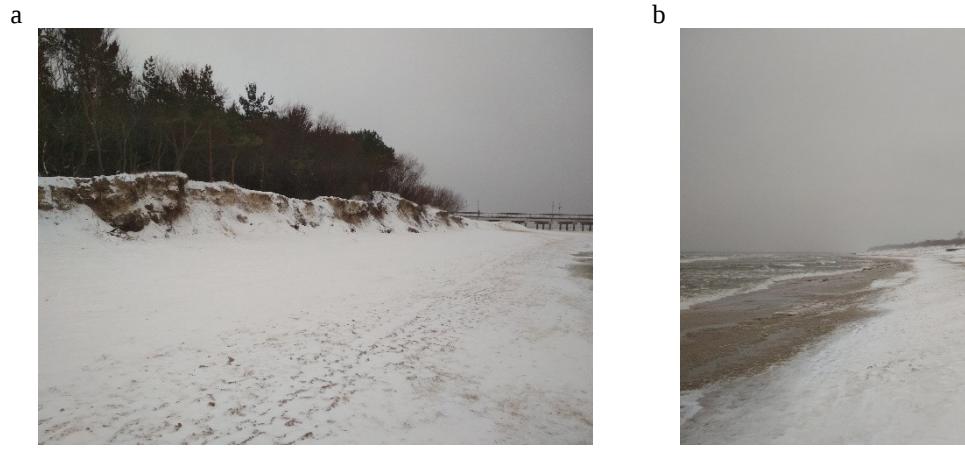
Beach nourishment completed in 2012 and groyne reconstruction at Palanga pier have slowed down an erosion processes in a southern section (Birutės hill –Palanga pier stretch). However, in a northern section (Palanga pier – Ražės stream stretch) erosion processes have become more intensive (Fig. 2).