
Researches of pressure measurements are mostly made for the laying body pressure on a bed like surfaces. The analysis for sitting position is realized for car or agricultural vehicle seats to find most comfortable materials and designs. Although, analysis of human fatigue in a seated working place based on pressure measurements is not widely investigated. Most papers of sitting pressure measurements [1] made to prevent development of pressure ulcers for disable people, who cannot move and do not have feeling in a lower body, while seated in wheelchairs [2].
The motivation for this topic comes from fatigue behavior of human tests and ergonomics of seated working places. As studies have shown, many adults spend 70% of their waking hours sitting and little or no time exercising in a result experiencing pain in the back, neck, and shoulders. Sitting in uncomfortable chair requires greater muscular force and control to maintain stability and equilibrium, which leads to fatigue and discomfort [3]. Project tests would analyze people behavior while sitting on different surfaces (different size of chair cushions and design of chair) based on the measured pressure and find parts where the highest pressure is concentrated.
In this project, main objective is to design the sensing mat (Fig. 1) and test it. The pressure-measuring mat should be adjustable in purpose to move it through different sitting surfaces. In this project pressure sensing is done with Interlink Electronics force sensing resistors (FSR-part no. 402), which increase the resistance with increasing force applied on the sensing area. Sensor connected with resistor of known value creates voltage divider, where drop of input voltage corresponds to weight applied on the sensor. The program of measurement reading and visualization is created in Matlab package Simulink. Where, data from 16 sensors is obtained in 10 Hz sampling time and converted from voltage change to grams by prescribed function. Values of sensors are visualized as color matrix corresponding to sensor placement. Moreover, data measured over time is stored in Matlab workspace, where it can be reused for further examinations.
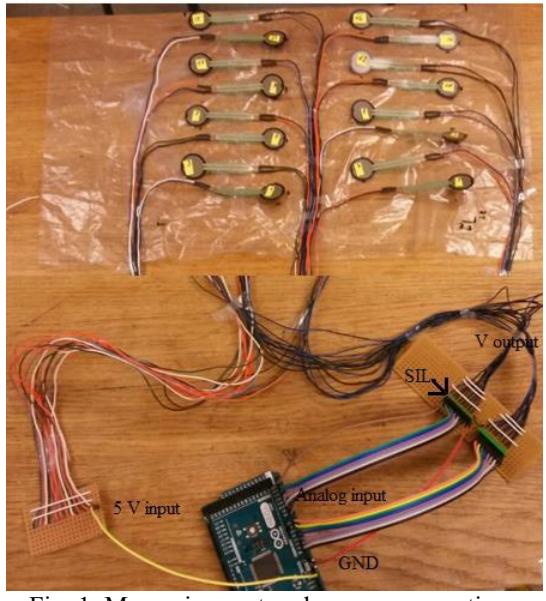
Measurements show that, pressure measuring mat can be affective with matrix 4x4. Having more sensors that can cover all sitting surface can represent data of leg position more detailed. Furthermore, small spacing between sensors can result in very low readings of particular places where is low pressure. Spacing of the sensors also depends on tested body anatomy for important data reflection.
Measured value can change from 20 g to 60 g depending on the sitting surface (hard or soft), because of this variation precise tests have to be performed on different surfaces. For this reason, mat can be used for comparison of pressure of different parts, but not precise measurements of the weight.
Humans of different body physique should be tested to find optimal spacing of the sensors. Fatigue study should be run, to show how pressure changes over long period of time not changing sitting position.