
Machining using nanosecond lasers is commonly used in science, technology and medicine. However, how to use the expensive laser irradiation efficiently is an important and still open question. Many types of materials are used for laser ablation, but few as widely applicable as copper because of high material removal rate and superb processing quality. Using laser irradiation, it is possible to cut, drill and form three-dimensional structures in copper [1]. Laser ablation rate depends on various processing parameters, such as: beam scanning speed, laser power, fluence and pulse repetition rate. In this study, optimal parameters for efficient copper ablation were found experimentally and confirmed theoretically by a commonly-used model.
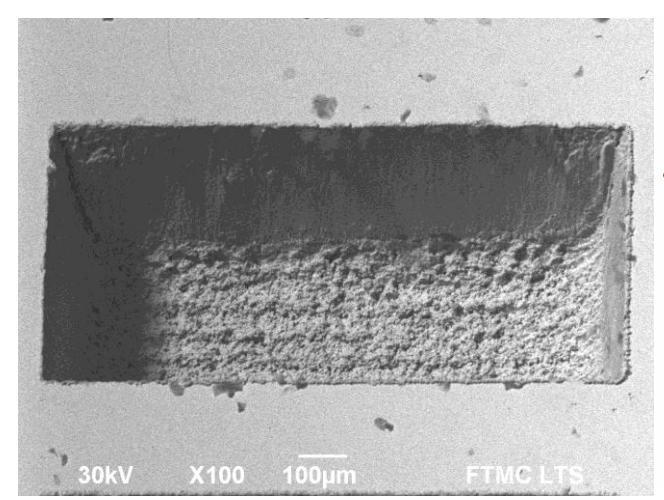
Rectangular cavities were ablated in a copper sample using a nanosecond laser (Fig. 1).
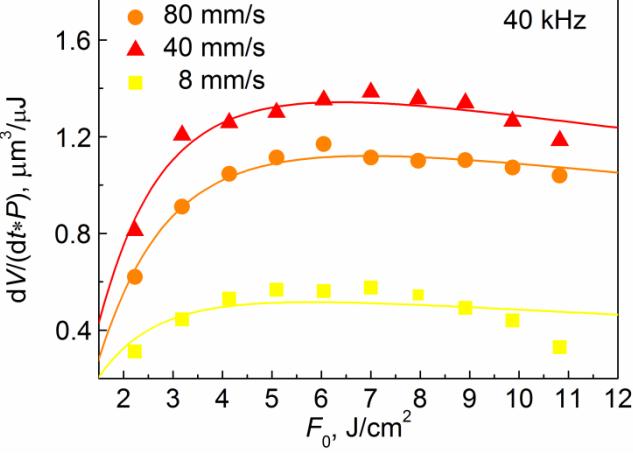
Experiments were performed at different pulse repetition rates. The beam scanning speed was linearly adjusted to repetition rate in order to keep the distance between laser pulses fixed. The focused beam spot size on the sample was 40 μm. The laser fluence was increased by changing pulse energy. The profiles of laser ablated cavities were measured by a stylus profiler. The surface roughness and the volume ablation rates per average power, also called as specific removal rate or ablation efficiency, were evaluated from profiles at different processing parameters (Fig. 2). The optimal fluence for highest removal rate on copper was found in the 10 – 40 kHz range, which was around 5 - 8 J/cm2 (Fig. 2). For laser micro machining with a Gaussian beam the volume ablation rate per average power can be described as a function of the laser peak fluence [2]:
$$\frac{\mathrm{d}V}{\mathrm{d}t \cdot P_{\mathrm{av}}} = \frac{1}{2} \frac{\delta}{F_{0}} \ln \left(\frac{F_{0}}{F_{\mathrm{th}}}\right)^{2}.\tag{1}$$Here $\mathrm{d}V$ is removed volume of the material, $\mathrm{d}t$ – ablation time, $P_{\mathrm{av}}$ – average power, $F_0$ – laser peak fluence, $F_{\mathrm{th}}$ - ablation threshold and $\delta$ - energy penetration depth. According to the theoretical model mathematically described by Eq. (1) there is an optimal fluence at which material is removed most efficiently (Fig. 2). The optimal scanning speeds for the most efficient ablation at 10, 20, 30 and 40 kHz repetition rates were found 10, 20, 30 and 40 mm/s, respectively.
It was shown, that using the optimal laser fluence and scanning speed not only yields highest ablation rate, but lowest surface roughness as well. This is explained due to the fact, that the chosen speed reduces the ablation threshold but does not allow for saturation of ablation depth. Using this method, two technologically important parameters are optimised at once.