
Helium (4He) is an element with a nucleus containing two neutrons and two protons. It is being emanated during nuclear decay of radioactive elements as an alpha particle. Geological massifs containing minerals and rocks which have uranium and thorium are the source of helium on Earth [1, 3]. In Lithuania 4He can be detected in groundwater of the Baltic Artesian Basin (BAB). Crystalline basement is mainly made of magmatic and metamorphic rocks which contains radioactive elements emanating alpha particles. Alpha particles are being ionized shortly and become helium. Due to 4He nature it tends to escape geological environment through faults and porous media. Part of helium dissolve in groundwater (4He solubility in water is worst of all gases) [1, 2, 3]. Permeability of aquifers and aquitards are the key factor determining helium concentration in groundwater. The better the groundwater is confined the more likely helium would accumulate. In BAB groundwater helium concentration correlate with aquifer depth. The deeper and more confined aquifer groundwater is more saturated with the helium gas than shallow layers. Helium anomalies can be detected in the fault zones, where deep groundwater (usually brakish or brine) forms an intrusion to the shallow aquifers. In these cases shallow and deep groundwater mixing occurs leading to alteration chemical, isotopical and gas composition of groundwater [2, 3, 4].
During the fieldworks fifteen samples of groundwater were collected for this study. Eight samples were extracted from shallow wells of Quaternary aquifer system (up to 125 m depth) and seven samples from deep boreholes (300 – 1011 m depth). Sampling sites were selected to represent most of the BAB aquifers in Lithuania. Samples were prepared for chemical, isotopical and helium analysis which was executed in the laboratory. Physical-chemical parameters (pH, Eh, T) were measured during sampling process. Helium is a very volatile element, therefor sampling procedure is complicated. Each sample is collected in to the glass bottle which has to be quickly filled with water and clogged with a rubber cork to avoid helium escape.
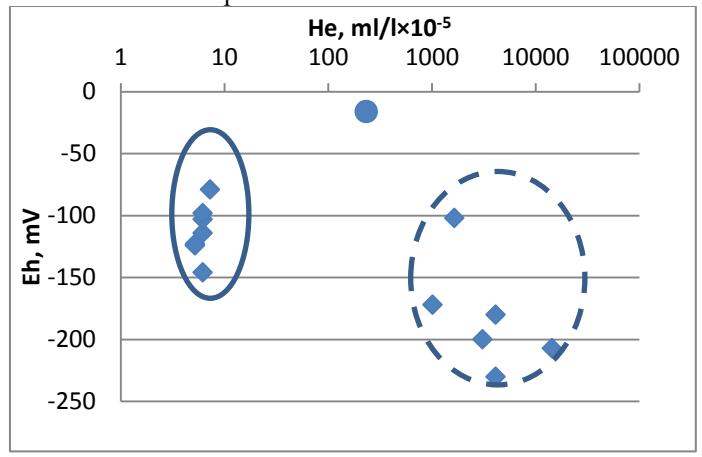
The shallow aquifer groundwater helium concentration is equal to atmospheric. Helium is not being accumulated and most of it coming from below is released into the atmosphere except small portion of 4He, which shows equilibrium. Deep aquifer groundwater helium concentration values are between 232 and 14430 ml/l×10-5. Comparing helium data with the chemical composition of the groundwater reveals that metamorphisation degree ((rNa++rCl-)/rHCO3-) and chloride is proportional to helium concentration. Deep aquifers groundwater composition is different from the shallow because of the recharge intensity, interaction with a surrounding minerals, mean residence time, etc. Oxidation-reduction potencial (Eh, mV) and helium concentration graph (Figure 1) shows two distinct groundwater environments. Shallow aquifers groundwater with small amounts of helium have Eh values -150 – -60 mV (smooth circle line). Deep groundwater with the accumulated helium have Eh -230 – -100 mV (dash circle line). An exception is in Telšiai site (well Tichė) were groundwater type is calcium – sulphate type (circle point). This groundwater type deviates from usual BAB groundwater also altering hydrogeochemical environment (Eh).