
Protonated water dimer ($H^{+}_{5}O_{2}$) attracts researchers' attention as one of the simplest protonated water clusters, investigations of which are interesting both for better understanding of proton transfer mechanisms and hydrogen bond properties. Our recent investigations [1,2] shed some light on the dynamics of the shared proton stretching vibrations. The problem is that we have to compare calculated IR spectra with experimental IR spectra of the $H^{+}_{5}O_{2}+X$ complexes, where X=Ar,Ne,He acts like a carrier. According to [3] these complexes exist in only one configuration where protonated water dimer loses $C_{2}$ symmetry. This fact was confirmed both by the data of calculations represented in work [4] and by our calculations performed in frame of standard DFT methods. At the same time it is clear that due to dipole moment of free $H^{+}_{5}O_{2}$ directed along $C_{2}$ symmetry axis the most strong interaction between protonated water dimer and inert gases is expected when the last two are accommodated on $C_{2}$ axis.
We assumed that the failure of standard DFT methods to locate $H^{+}_{5}O_{2}+X$ complexes with $C_{2}$ symmetry is because of the lack of dispersion interaction accounting. Based on these considerations, we used wB97XD density functional which takes in account dispersion interaction [4]. Using wB97XD/acc-pVTZ level of theory we were able to find configurations of the $H^{+}_{5}O_{2}+X$ complexes with $C_{2}$ symmetry for all X= Ar,Ne,He. Equilibrium configuration of the $H^{+}_{5}O_{2}+Ar$ complex with and without $C_{2}$ symmetry represented on Fig.1.
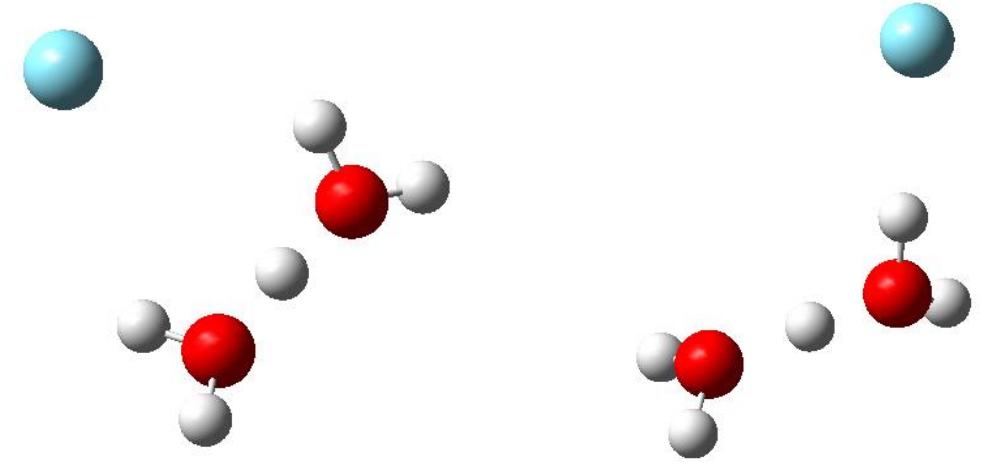
According to the calculations it was found that for all inert atoms complexes with $C_{2}$ symmetry posses much smaller distorted geometry and IR spectra of free protonated water complex and shared proton remains at the centrum of the hydrogen bridge. A different situation appears in complexes without $C_{2}$ symmetry. The shared proton tends to move towards the water molecule that is closer to Ar/Ne/He. Calculated IR spectra of such complexes differ strongly from the free complex ones. In case of Ar atom this shift is more significant. So we can assume that addition of the Ar/Ne/He atom to the PWD molecule stabilizes the $H_{3}O^{+}$ fragment of the PWD. Our calculations confirm the deformation of the $C_{2}$ configuration, but for both complexes ($H_{5}O_{2}+Ar$, $H_{5}O_{2}+Ne$, $H_{5}O_{2}+He$) the water molecules are still oriented with respect to each other similarly as in the case of the $C_{2}$ configuration, i.e. only the proton shifts towards one of the monomers without relative rotation of the water molecules; the shift in the case of $H_{5}O_{2}+Ar$ is significantly bigger than in the case of $H_{5}O_{2}+Ne$ and $H_{5}O_{2}+He$ but the $O_{1}O_{5}$ distance is in neither case hardly affected compared to the case without carrier gas. At the same time existence of the $H^{+}_{5}O_{2}+X$ complexes with $C_{2}$ symmetry still questionable in spite of the fact that experimental spectra rather say in favor of their existence. The further investigations are needed.