
Hydrogen evolution technology is considered as a key element for a sustainable economic growth and generation of a clean energy [1]. As usually precious platinum is typically applied in electrocatalytic systems for hydrogen evolution reaction (HER), the development of new cost effective and durable materials, which possess high catalytic activity for HER, is necessary. The metallic Mo or its alloys can be used as active electrodes for hydrogen evolution [2-4]. This kind of electrodeposits can be obtained by using non-aqueous and molten salt electrolytes [5]. Unfortunately, the pure Mo deposits cannot be obtained from aqueous molybdate solutions. Only by induced co-deposition process with iron group metals (Ni, Co, Fe) the Mo alloys with high content of refractory metal in the alloy can be obtained [6].
In this study Mo-rich Ni-Mo, Co-Mo, Fe-Mo alloys were electrodeposited onto copper substrates from highly concentrated acetic electrolyte and characterized in terms of their morphology and composition in the view of possible application for HER in alkaline solution. Smooth, globular and crack-free coatings containing ~ 52 at.% Mo in their composition were obtained under galvanostatic mode at 30 mA/cm2 at 30 °C. At the higher current densities the cathodic current efficiency decreases dramatically and extremelly high percentage of oxygen is incorporated into alloys' composition.
Electrocatalytic activity towards cathodic hydrogen evolution in 30 % NaOH solution at the temperature range of 25-65 °C on the electrodeposited Co-52at.%Mo, Fe-54at.%Mo and Ni-54at.%Mo alloy coatings was evaluated by means of voltammetry technique. It was found that the exchange current density of hydrogen evolution reaction for Co-52at.%Mo and Fe-54at.%Mo deposits was considerably higher than for Ni-54at.%Mo alloy coatings. A significant improvement of catalytic activity for all tested coatings with increasing of the temperature was noticed (Fig.1).
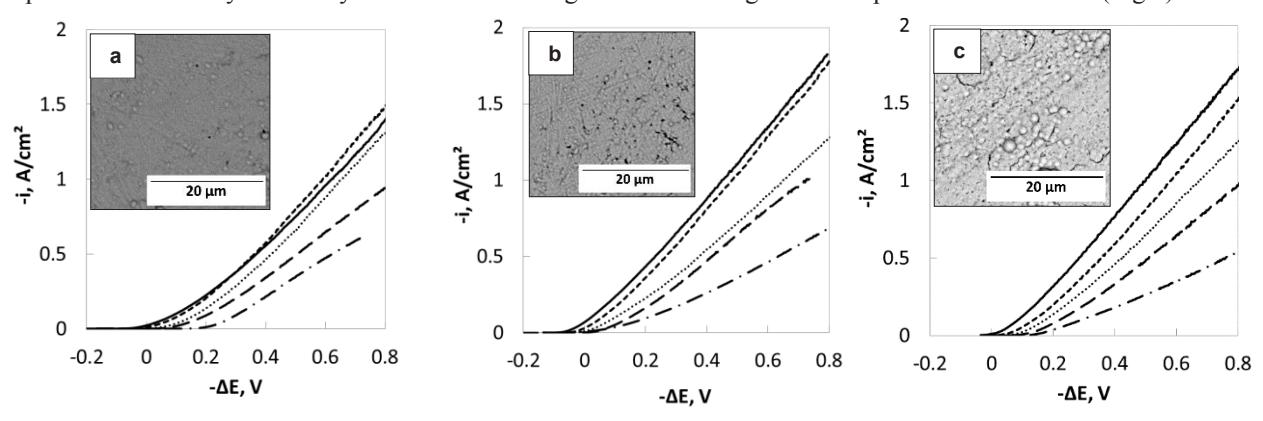
Extrapolation of the polarization curves obtained at different temperatures, in the coordinates $ln i - \Delta E$ to value $\Delta E$=0 makes it possible to determine the exchange currents densities (ECD) that describe the ability of electrode to reduce hydrogen ions from electrolyte. In this study, the highest calculated ECD value for HER at 65 °C (~0.45 A/cm2) was demonstrated for Co-52Mo and Fe-54Mo alloy coatings. Moreover, Fe-54at.%Mo and Co-52at.%Mo electrodes are characterized by slightly lower activation energy, respectively 26.5 and 27.0 kJ/mol, compared to Ni-54at.%Mo coating (29.9 kJ/mol).