
Recently increased environmental consciousness and the search of new renewable raw materials has led to the increased interest of both polymer research and industry. For the production of polymers it is desired that polymer would have properties similar to those of petroleum-derived polymers and be able to decompose into harmless substances after use.
Natural oils have become the center of attraction for their potential use as starting materials for the preparation of polymers due to ready availability, inherent biodegradability, limited toxicity, and existence of modifiable functional groups. [1,2] Natural oils possess unique characteristics of biodegradation, biocompatibility and structure versatility which make it possible to develop a variety of novel polymeric materials.[3,4]
The aim of this study was to investigate the biodegradability of the cross-linked linseeed oil-based photopolymers and polyphosphates synthesized with and without reactive diluent bis[4-(glycidyloxy)phenyl]methane as well as their composites with industrial waste materials of natural origin (horn meal, pine needles, pine bark and mix of grain waste and weeds). Utilization of renewable resources instead of petroleum sources and their biodegradability in different environments enable such polymers and polymer composites to be more easily acceptable than the conventional plastics. [5]
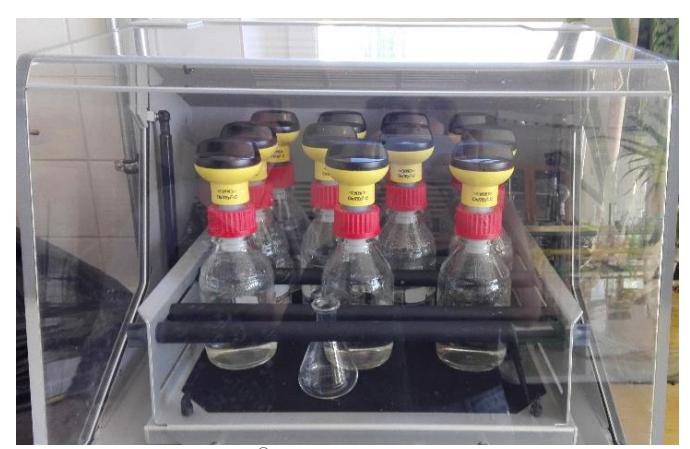
Biodegradation of the cross-linked linseeed oil-based photopolymers, polyphosphates and their composites was investigated by the respirometric method. This method is based on changes in pressure following oxygen consumption in a hermetically closed bottle containing the sample. This apparatus measures the oxygen consumption almost continuously over the incubation period. The measurement of biochemical oxygen demand with OxiTop® respirometric measuring system was carried out according to the standardized procedure ISO 14851.
It was determined that the biodegradation rate of all linseeed oil-based cross-linked polymers was lower than that of cellulose which was used an internal standard. The biodegradability of the investigated cross-linked polymers depended on amount and chemical structure of the used reactive diluent. The higher amount of aromatic reactive diluent was used in the reaction mixture for the synthesis of photopolymers the lower biodegradation rate was determined. The higher amount of aromatic reactive diluent was used in the reaction mixture for the synthesis of polyphosphate the higher biodegradation rate was determined. The biodegradability of the linseeed oil-based polyphosphate composites depended on the amount and nature of industrial waste filler. The highest biodegradation value was determined for the polymer composites filled with mix of grain waste and weeds. The lowest biodegradation value was determined for the polymer composites filled with horn meal.