The ordered monolayers of the trimesic acid (TMA) molecules are one of the simplest examples of a two-dimensional self-assembly. These triangular molecules usually form honeycomb-like patterns on noble metal and graphite surfaces. It was also observed that the centers of the hexagons constituting such honeycombs can be occupied by the TMA or other molecules. This makes such orderings highly attractive examples for studying guest-host interactions. However, the experimental scanning tunneling microscopic techniques lack resolution to fully resolve the position and orientation of these guest molecules [1]. Thus, theoretical ab-initio and statistical (Monte Carlo) calculations serve as an alternative tool for detailed understanding of such orderings.
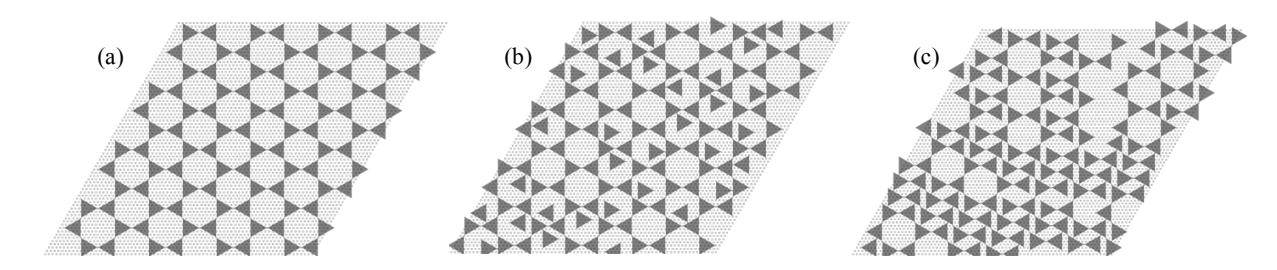
In this work, we propose a relatively simple statistical model to describe the ordering of TMA molecules into honeycomb phase with filled hexagons. The model consists of two types of the short-range TMA-TMA interactions that are caused by the H-bonds between the molecules. The main interaction is responsible for formation of the honeycomb phase (see Fig. 1a). The weaker interactions occur between the central molecule in the hexagon and the rest of the honeycomb. The relative values of these interactions are calculated with by the density functional theory (DFT), while the whole model is simulated using the Monte Carlo method.
During the simulations, we calculated energy and heat capacity of the TMA system for various temperatures and molecular concentrations. The obtained snapshots of simulation (Fig. 1) display the low-temperature ordered structures including the honeycomb, the honeycomb with filled hexagons and dense phases.