The antisymmetrization of a given system and the center of mass (CM) elimination must be ensured for the wave function of nuclear system. CM problem is easily solved by direct construction of the CM free wavefunction in terms of the relative (Jakobi) coordinates of an identical fermions. If the Jakobi coordinates are used, then the antisymetrization procedure can be done in isospin formalism and the use of Slater determinants is not needed. By using this type of approach the spurious state elimination is avoided and significant reduction of matrix dimensions is achieved.
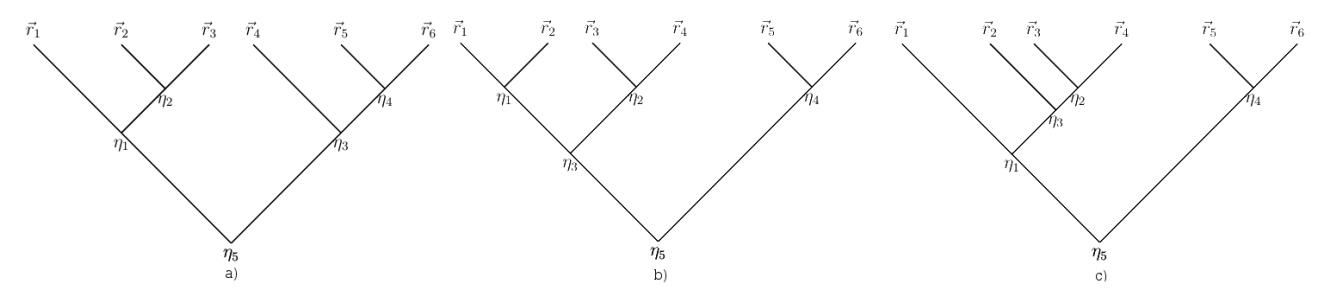
Wavefunction antisymmetrization for a six body system can be based on eigenvalue calculation of two particle transposition operator $P$ of a symmetry group $S_6$. In this method, six particle system can partitioned into different types of sub-clusters. For example, six particle system can be partitioned into three particle subclusters and subclusters made from four and two particles. (Fig.1). The basis states of subclusters must be antisymmetrized before the antisymmetrization of whole system [1]. Then the six body system can be characterized by good quantum numbers: Oscillator quanta $E$, total angular momentum $J$, parity $\pi$, isospin $T$ and additional integer quantum number $\Delta$ for unambiguous enumeration of the basis states.
In presentation, the procedure of antisymmetric basis state construction for six particle nuclear system in different types of clusterization will be given, as well as calculation results..