
The search for alternative methods of recording and storing information is relevant in the age of rapid development of information technology. Existing methods allow to record huge data streams in a miniature form, but in these cases there is a risk of information loss under various external factors like high temperatures, influence of electric and magnetic fields, as well as radiation.
The first publications devoted to the development of methods for recording information inside transparent materials appeared in the last 5-7 years [1]. These methods are devoid of the above disadvantages and at the same time have a sufficiently high recording density. However, specialized high-precision optical equipment is required to read the information.
The purpose of this paper is to develop a method of recording information inside transparent materials using the phenomenon of laser breakdown and precision laser processing [2], for reading which the simplest optical equipment can be used.
After a detailed study of the phenomenon of laser breakdown, we found that the microdefect has an asymmetric structure of complex shape close to an ellipsoid with a system of microcracks. To form microdefects inside the glass the ELS-02M device is used. The changing of the energy of the pump lamp makes it possible to create regions of microbreakdown of different size. This fact formed the basis of the method of recording information.
To form information states in the glass, microdefects of two sizes are created. The absence of a microdefect is defined as the third information state. Areas without a microdefect are assigned an information state of "0", and microdefects arranged in ascending order of sizes are assigned states of "1" and "2", respectively.
Considering the small size of microdefects, the reading algorithm is based on the layerwise registration of the defect arrays observed through an optical microscope with the necessary resolution.
An application was designed to read the recorded information. It allows you to convert photos of microdefect regions to the corresponding matrix of states. The program consists of two main blocks. At the first stage, the program processes primary images of microdefects and converts them into binarized images. The second block, based on machine learning algorithms, converts microdefect images into digital code. The workflow of the application is shown in Fig. 1.
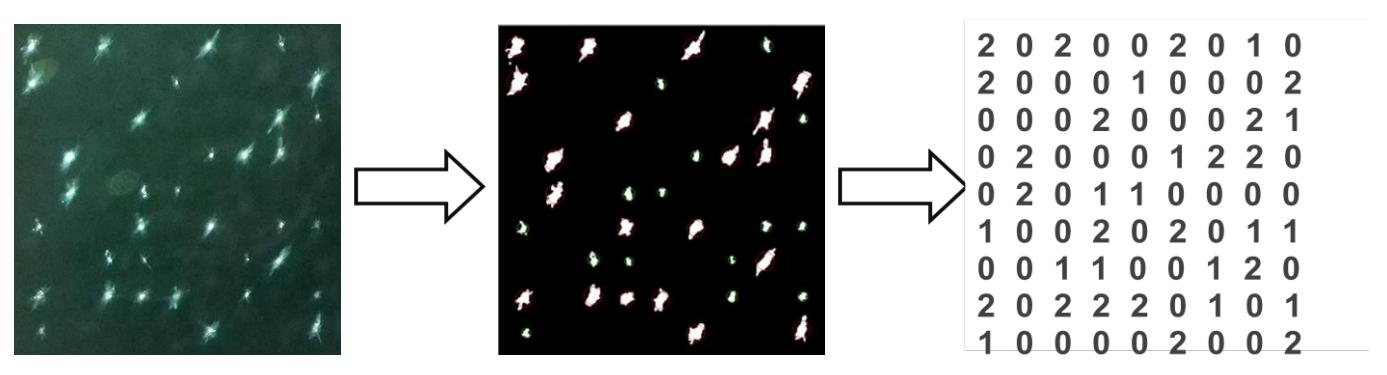
The proposed method has a sufficiently high recording density, since one region of microbreakdown corresponds to 3 information states, and for our experimental conditions, about 80,000 defects can be formed in a cubic centimeter of the glass. The developed system of information reading was successfully tested on experimental data sets. Unlike the analogues, for data recognition we need only a simple optical microscope and a digital camera.