Currently, the black hole at the center of the Milky Way is inactive, but there are reasons to believe it was not always so and there were at least two activity periods in the recent past [1]. The first of these, happening a few million years ago, could be responsible for the formation of the Fermi bubbles [2]. It is suggested that such an event could be initiated by a perturbation of the molecular gas ring that surrounds the black hole by an infalling molecular cloud.
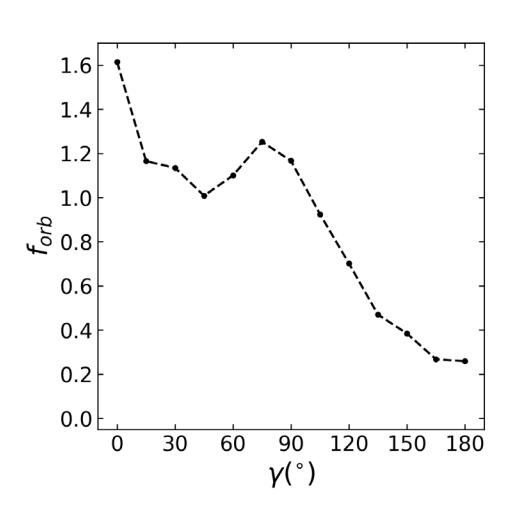
We aim to reproduce this process with a hydrodinamical model. The model consists of three main components: central black hole $(M_{bh} \sim 4 \times 10^6 {\rm M}_{\odot})$, a ring of molecular gas $(R_{in} = 1.5 {\rm ~pc}, R_{out} = 4 {\rm ~pc})$ and a molecular cloud $(R_{cloud} = 1 {\rm ~pc})$. The initial masses of both the ring and the cloud are chosen similar to the lower estimates of the mass of the circumnuclear ring $(M_r \simeq M_{cl} \sim 10^4 {\rm M}_{\odot})$. By varying the initial inclination angle $(\gamma)$ of the orbit of the molecular cloud we change the outcome of the encounter, including the rate of black hole accretion and the morphology of resulting structures.
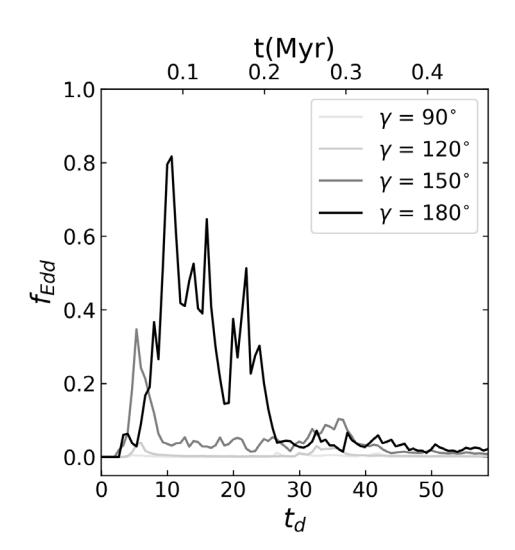
We find that the black hole accretion rate is dependent on the initial angle and reaches up to $\sim 0.8 \dot{M}_{Edd}$. Also the morphology of the system is affected by the change in $\gamma$ - systems with initial angle $<=60^{\circ}$ do not produce a central disk and more highly inclined initial orbits lead to a more compact and less massive resulting ring. Energy liberated during the nuclear activity period is equal to about 3% of the energy required for Fermi bubble formation with initial ring mass $\sim 10^4 {\rm M}_{\odot}$. The highest possible ring mass $(\sim 10^6 {\rm M}_{\odot})$, combined with an equivalent cloud mass, would produce the required energy.