
The beach is one of the most sensitive elements of sandy coast, changing constantly during short period of time. Hydrodynamic and aeolian processes act as the main driving forces changing the cross-shore sediment exchange between nearshore, beach and foredune. However, despite the extremely dynamic environment, morphological elements of coast (beach, foredune) remain stable.
The aim of this paper is to determine changes in the beach morphometry during accretion and erosion dominated periods.
In order to evaluate the change of beach profile in sectors with dominated accretion (Smiltynė) and erosion (I Melnragė) processes, the changes in beach morphometry that occurred during 2002-2017 period were analyzed. The leveling of the beach cross-sections has been performed in May of every year in calm weather conditions since 2002. The following morphometric indicators were chosen for analysis of morphological changes of the beaches: beach width (horizontal distance from the coastline to the foredune toe), beach slope ($θ$ – the ratio of the beach height near the foredune toe and beach width), beach volume and position of shoreline. These parameters were selected as being the best to represent the features of beach profile.
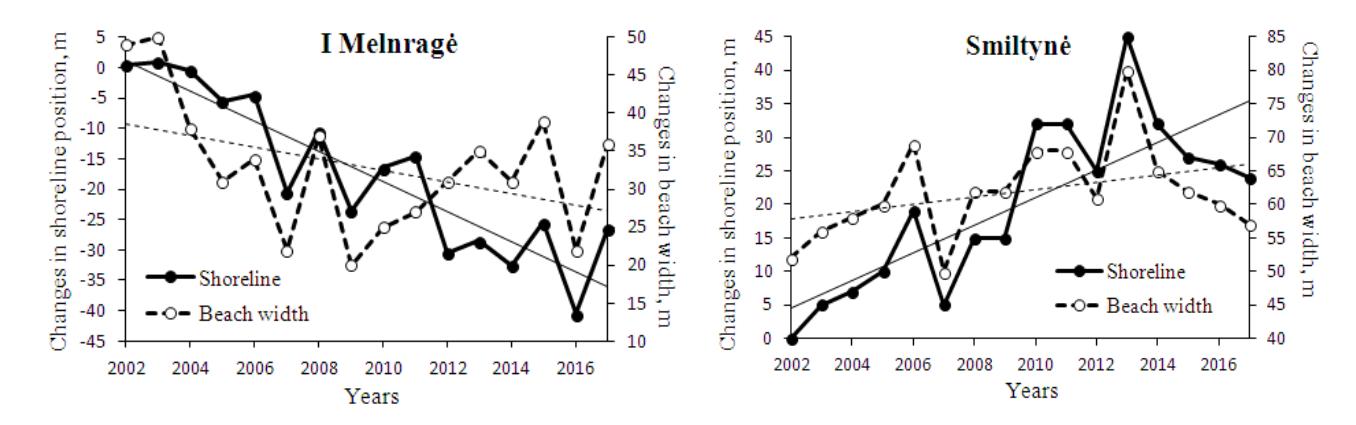
Analysis of change in beach morphology has shown (Fig. 1) that, despite an intensive fluctuation of shoreline position, the beach width and volume remained almost unchanged. In case of I Melnragė where shoreline position during 2002-2017 period moved landward more than 30 m, beach width shrunk only 15 m (from 50 to 35 m). Whereas in case of Smiltynė where shoreline position moved about 30 m seaward, beach widened only 5 m (from 50 to 55 m).
Their temporal stability can be explained the formation of incipient dune near established foredune toe in the coastal sectors with prevailing accretion period. In the coastal sectors with prevailing erosion, the narrowing of beaches allows the waves to erode the foredune. Eroded material from foredune nourished the beach, resulting in the recovery of beach profile. In such way, the beach profile retains quasi-stability in the coast dominated by accretion processes as well as in the coast with prevailing erosion processes. Thus, the beach profile tries to return into equilibrium with the forming factors.