
Despite the increasing energy efficiency of modern electronic devices, the batteries are still the relevant part and determine the usefulness of the entire device. The investigated compound of $LiFe_xMn_{1-x}BO_3$ is proposed to be applied as cathode material in the most common kind of batteries – Li-ions. It is motivated by high value of theoretical gravimetric capacity 220–222 mAhg-1 (depending on the composition) and satysfying conductivity taking into account an ease in synthesizing.
Previous studies in the Solid State Ionics Division showed gigantic increase of specific conductivity after thermal nanocrystallization comparing to the initial glassy sample [1]. The process consist in creating nanomaterial from glass through isothermal annealing at strictly determined temperature. The temperature must be choosen in the way to nucleation process of new crystal grains will be the highest. The nanometric crystalline grains are formed in the sample, which are responsible for observed conductivity enhancemnet. Investigations of LiFeBO3 subjected to nanocrystallization showed increase of conductivity by more than 6 orders of magnitude vs glass. Nevertheless, the difficulties appeared in obtaining the sample in a glassy state [2], which is required for further process. The LiMnBO3 admixture should have solved mentioned issue, because of its' good glass-forming properties [3]. The aim of this mixed compound was to combine satysfying conductivity with an ease of obtaining the sample in a glassy form.
Glassy compositions of LiFexMn1-xBO3 for x = 0.25, 0.5, 0.75 were obtained using melt-quenching method. Thermal (DTA), structural (XRD) and electrical (IS) reseraches were employed to characterize as-prepared glasses.
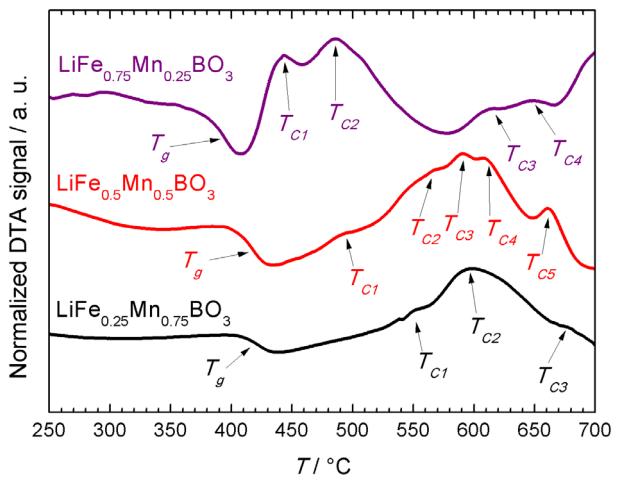
Determining the temperatures of essential (from the viepoint of this work) thermal events, showed translation into side of higher temperatures for the samples with higher content of manganese (a). Glass transitions were registered in the range 395–421 °C depending on composition. First peaks of crystallizations appeared at 551, 489, 443 °C for samples with x = 0.25, 0.5, 0.75, respectively. Structural measurements showed that ideally amorphous phase was obtained for samples with x = 0.25, 0.5 only, whereas, for x = 0.75 visible was slight content of Fe3O4 phase. For the all three compositions characteristic was lack of changes in the structure till 400 °C. Above this temperature mainly the phases of FeBO3, LiMnBO3 appeared.
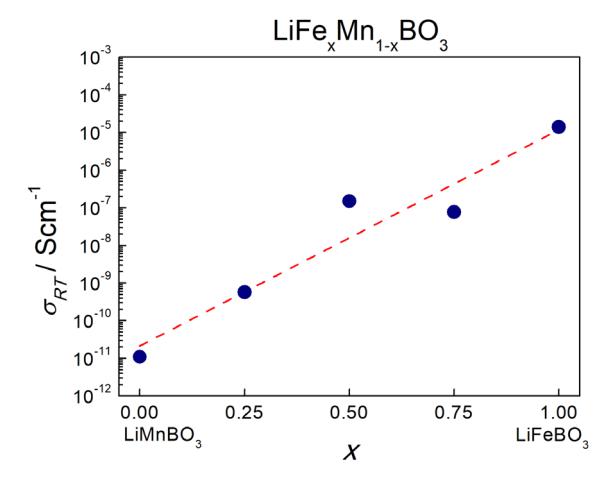
For different samples, the most beneficial was different temperature of nanocrystallization, considering increase of conductivity. The best result was registered for LiFe0.5Mn0.5BO3 (x = 0.5) sample, where the increase of specific conductivity was by a factor $5 \cdot 10^7$ after annealing at 450 °C versus initial glass. The dependence of conductivity on content of iron in composition was also determined (b). This relation has an exponential character with increasing amount of iron in the sample.