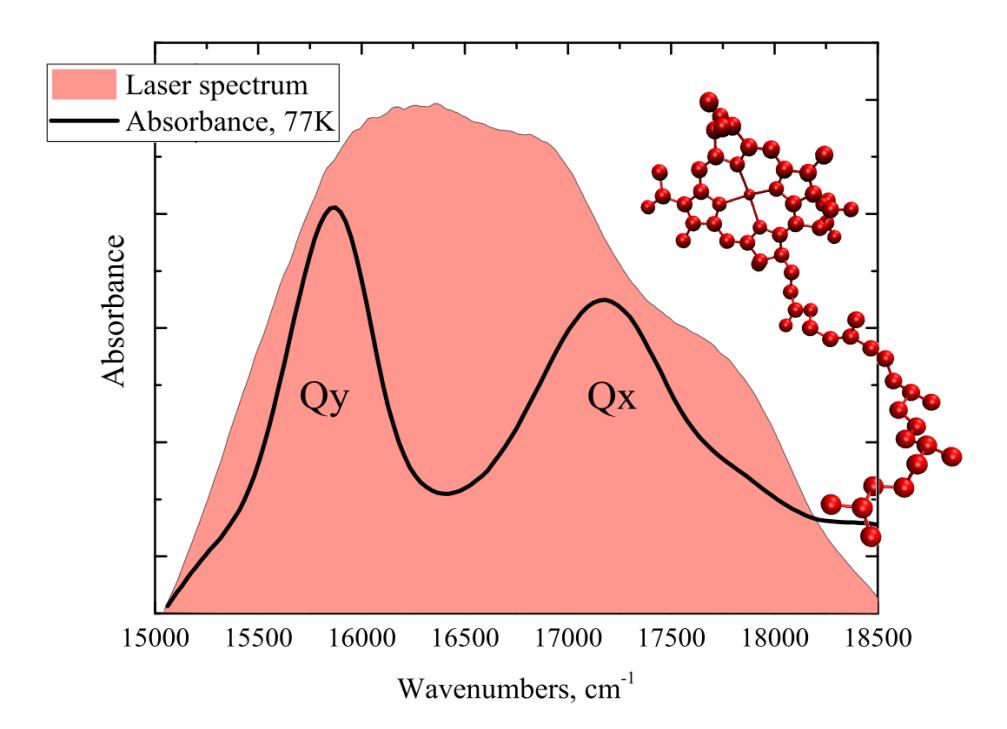
The principal pigments related to absorption of light and transfer of excitation energy towards reaction centers are chlorophylls (Chls). In addition, Chls play a role in charge separation and electron transfer [1]. These molecules are known to have two electronic Qy and Qx transitions, with almost perpendicular polarization with respect to each other, as well as prominent vibrational progressions. The interplay among these electronic excited states and their vibrational degrees of freedom – vibronic coupling – is known to mix the characters from both states. In practice this means that a vibrational side band of the Qy state can absorb (or emit) in both Qy and Qx polarization directions [2].
In photosynthetic molecular systems (Reaction centers, Fenna-Matthews-Olson complexes), vibronic coupling is suggested to play a role in charge transfer [3, 4] and influence the lifetime of coherences within the system [5, 6].
Vibronic coupling can be probed using specialized measurements, such as two-dimensional electronic spectroscopy (2DES), where short coherent laser pulses can excite ladders of states in phase. The coupling is detectable throughout a quantum coherence – a superposition between two levels – and is observed as oscillatory beatings between those levels.
Although known to be of a great importance, no beatings between two electronic levels were observed in Chls using 2DES spectroscopy. One of the most probable explanations being that transition dipole moment of Qx level is just too weak to be probed. In this work we present a 2DES polarization study of Chlorophyll c molecule, where Qy and Qx transitions are almost of the same intensity (See Fig. 1), in order to find out: where did all the beatings go?