
The usage of biosensing systems is promising - rapid and accurate method for detection and analysis of various compounds. Nowadays one of the best-known and the most common biosensors are the glucose biosensors. They can accurately detect concentration of glucose in blood during a short period of time - it is very important to people with diabetes [1]. The active part of the biosensor is a glucose oxidase (GOx) enzyme immobilized on the surface of the electrode. When constructing an enzymatic biosensor, one of the most important aims is to determine properties of an enzyme under different environmental conditions. Despite the increasing number of studies on GOx, there is little information about the properties of the enzyme at different pH conditions [2].
Spectroscopic properties of glucose oxidase (GOx) and flavin adenine dinucleotide (FAD) were investigated in different acidity environments. The purpose of this research was to evaluate absorption and fluorescence spectra changes and to associate them with changes of GOx activity. The study of the absorption and fluorescence spectra and the measurements of relaxation times were carried out using a citric acid sodium phosphate buffer with pH values from 2 to 8.
GOx is a flavin adenine dinucleotide (FAD) containing glycoprotein. FAD is involved in enzymatic redox reactions and determines the enzyme's activity. GOx will lose its activity if FAD dissociates from the enzyme active site.
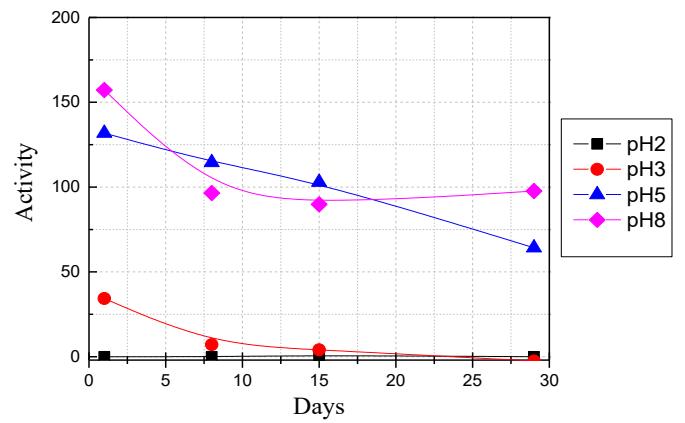
A. Ciucu described a fast spectrometric method of determining the activity of glucose oxidase [3]. The determination of GOx activity based on enzymatic reduction of benzoquinone to hydroquinone and on the measurement of the rate of increase of hydroquinone absorbance at 290 nm. Calculated changes of GOx activity during the 29-day period are shown in Fig.1.
The data analysis showed that at pH 2-3 solution acidity, the fluorescence intensities of FAD and GOx at 530 nm were the most intense. At pH 2, the GOx enzyme is completely inactive throughout the 29-day period. At the first day, the fluorescence intensity of GOx at the optimum pH (6) was the lowest and the activity of GOx was the highest compared to other pH solutions.
During this study, GOx activity trend was found: over time GOx's activity is decreasing. The increased intensity of the fluorescence band of GOx at 530 nm is associated with a decreased activity of an enzyme. The changes of fluorescence intensity band are associated with dissociation of FAD from the enzyme. However, the process is not reversible and the decrease of fluorescence intensity is associated with structural changes in the FAD: reduction of FAD, organic molecule aging process.