
Regulation of the cell functioning by means of electric field has already been described in a variety of works. However, the result of such studies is of interest as not only a basis for creating methods of tissue engineering, but also in the field of regenerative medicine [1]. Restoration of the damaged area of the cell monolayer is possible not only by regulating the proliferative activity of cells, but also by changing the direction of the cell growth. Thus, this work is aimed at studying the effect of long-term electrical stimulation (ES) on the direction of the cell growth.
Rat glioma C6 cells were used as the object of the study. The cells were incubated at 37°C in a humidified atmosphere of 5% CO2. A uniform alternating electric field was used for the long-term electrical stimulation of cells. The parameters of the applied electric stimuli were as follows: electric field strength – 50 V/m, the number of stimulating pulses in the train – 1, 5 and 10, the frequency of the trains – 10 Hz. The formation of the damaged area of the cells' monolayer was implemented with a pipet tip [2].
Earlier it was shown that the anisotropic growth of cells occurs when both the number of pulses in the train and the field strength was varied. However at a lower field strengths the fraction of cells oriented at an angle between 31°-60° increases with an increment of the total duration of the train [3]. The observed effect reduces with an increase of the field strength. As a result, an electric field strength of 50 V/m was chosen to study the restoration of damaged area of the cell monolayer.
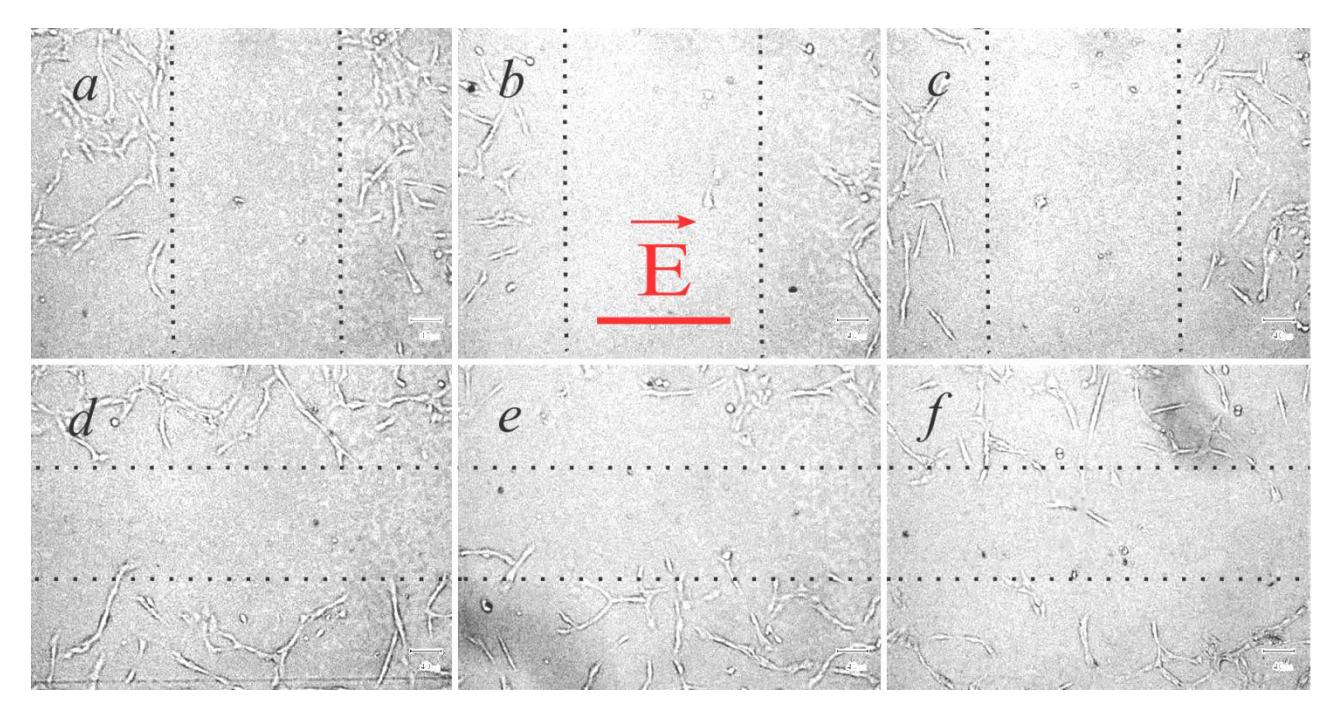
The anisotropic growth of cells was observed after the long-term electrical stimulation. Large fraction of cells was oriented orthogonally to the electric field vector, while in the control sample no significant changes in the growth direction was observed. The maximum effect of cell reorientation was discovered at 10 stimulating pulses in the train. It was found that the fraction of cells increased in the damaged area parallel to the electric field vector (Fig. 1f). On the contrary, no cells were found in the damaged area orthogonal to the electric field vector (Fig. 1c). Therefore, it was shown that due to the orthogonal reorientation of cells in accordance with the electric field, the fastest restoration of the damaged area is possible.