Interactions between mineral surfaces and aqueous solutions play an important role in a wide range of natural and industrial phenomena. Over the last years, a lot of scientific attention has been devoted to the exploring of structural and dynamical properties of various compounds in the interfacial and bulk regions. For such purpose, many experimental techniques like non-linear spectroscopy and X-ray reflectivity have been applied to investigate the origin of processes occurring at the mineral-fluid interface. With that, well-known theoretical approaches such as quantum chemical calculations and classical molecular dynamics (CMD) have allowed us to explain these interactions at the atomic and molecular level.
Recently developed theoretical method known as electronic continuum correction (ECC) [1] has been introduced to improve the accuracy of CMD simulations. The idea of ECC lies in the scaling of atomic charges to solve a problem of overestimated pairwise interactions in nonpolarizable force fields. The scaling factor must be equal to an inverse square root of the electronic part of the dielectric constant of the solvent (in the case of water, it is roughly 0.75). At the same time, Lennard-Jones parameters should be refined to provide reasonable interatomic distances. Therefore, so-called ECC-R (electronic continuum correction with rescaling) method combining both charges and van der Waals parameters rescaling has appeared. The importance and success of this technique was already shown for systems with ions [2], simple organic molecules [3], and proteins [4].
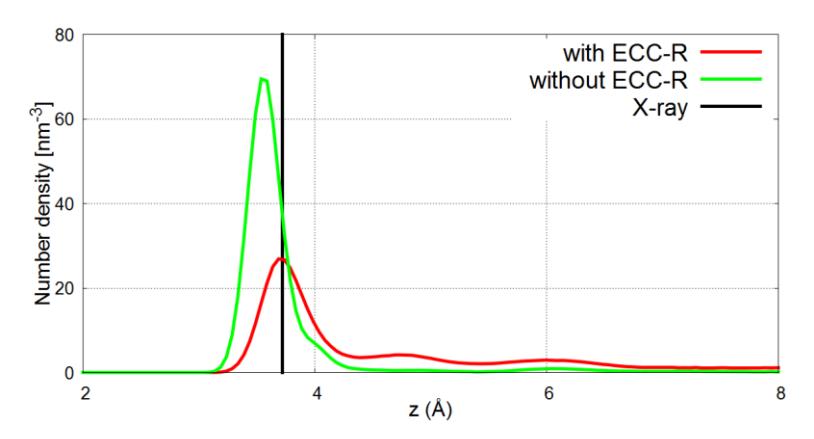
In our work, we applied ECCR method to model rutile (TiO2) surfaces (110) interacting with water and ions, namely, Na+, Rb+, Sr2+, representing small monovalent, large monovalent, and large divalent cations, respectively, and Cl- as counter-anion in the solution. The simulation setups were prepared in a similar way as in our previous works [5] with parameters modified according to the ECCR concept. We performed a set of simulations over a range of surface charge densities corresponding to different pH conditions. The output data (density profiles, interatomic interactions, adsorption sites, dynamical properties) were obtained and discussed. The results were compared against X-ray scattering experimental data [6], outcomes from the same system without applying ECC-R, and our previously published results (see Fig. 1 as an example). This comparison will allow assessing the benefits of the ECC-R method for studying similar systems.