
Layered van der Waals crystals are attracting increasing attention due to their excellent chemical and physical properties, leading to potential applications in next-generation photo-electronic devices.
The discovery of quantum emision in commercially available hexagonal boron nitride (h-BN) in early 2016 opens up applications in quantum computing, quantum communication and nanoscale sensing [1,2]. However, it is still unclear what is the exact mechanism of the measured quantum emission from defects in h-BN. Accurate modelling methods are required to garner extensive knowledge of these defects. Studies show that observed photoluminescence may come from point deffects located on linear defects like grain boundaries and dislocations. Using quantum chemistry calculations is too computationally expensive to model such large scale systems. Therefore, the goal of the present work is to use force field (FF) methods to model these systems.
In this study we used the classical Tersoff potential, developed for covalent systems, to model well known point defects in h-BN as a test for the accuracy of the potential. Eight different parameter sets for B-N systems, developed by different groups from 1996, were identified and used in this work. The results were compared with accurate density functional theory (DFT) calculations from other studies to find a parameter set most suited to model defects in h-BN.
Pristine h-BN monolayers of 2048 atoms were created with optimised geometry using periodic boundary conditions. Defect formation energies and geometries (bond lengths) of Stone-Wales (SW) and double antisite (AS) point defects (Fig. 1) were calculated for available Tersoff potential parameter sets.
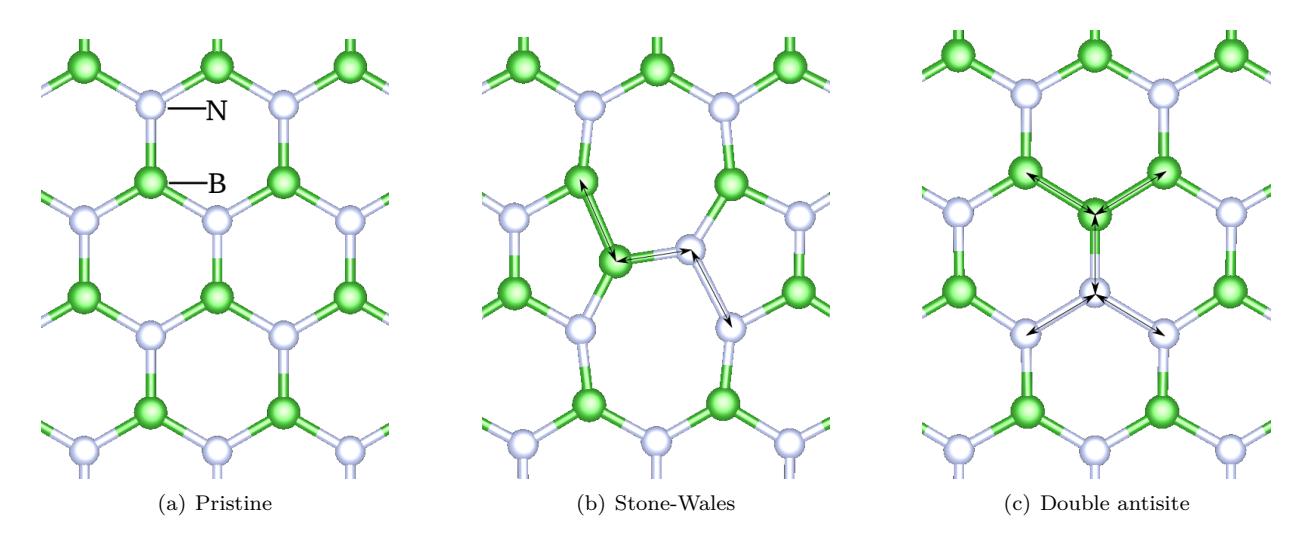
We find that defect formation energies are up to several eV larger than DFT calculation values. One specific parameter set gives rather accurate defect formation energy values however bond lengths are up to 0.15 Å longer than in ab-initio calculations. Accurate bond length values are required to correctly model large scale linear defects like grain boundaries or dislocations. We show that most widely used parameter set by Kınacı et al. for h-BN and graphene heterostructures is suited to model pristine monolayers but not to describe point defects [3]. These results show underlying problems in using currently available parameter sets to model defects in hexagonal boron nitride. New parametrisation for structures with defects is required, especially for nitrogen-nitrogen interactions.