
Prostate cancer (PCa) is the second most prevalent malignancy in men and the sixth leading cause of death in males with cancer worldwide [1]. It is known that PCa can be effectively treated if detected at early stages. The most common method for early PCa diagnosis is prostate-specific antigen (PSA) screening. However, this method has only 20% specificity, which often leads to unnecessary biopsies and overtreatment [2]. For this reason, the development of new molecular biomarkers for PCa is vitally necessary. Epigenetic silencing of tumor suppressor genes is a common feature of many cancers. Aberrant methylation of CpG islands in promoter region is considered as the earliest somatic genome change in cancer [3]. Thus, promoter methylation of tumor suppressor genes could be used as a potential biomarker for the early diagnosis of PCa.
The aim of this study was to evaluate the promoter methylation status of three tumor suppressor genes, namely, RARB, RASSF1, and GSTP1, in clinical PCa samples as potential biomarkers.
In the present study, 112 prostate adenocarcinoma samples and 16 noncancerous prostate tissue (NPT) samples from 113 PCa patients were analyzed for promoter methylation. The tissue samples were collected during 2008-2014 at Vilnius University Hospital “Santaros Klinikos”. Tumor suppressor genes were analyzed by means of methylation-specific polymerase chain reaction (MSP). Also, DNA from voided urine samples of 44 PCa patients were tested using quantitative MSP (QMSP). Prior to analysis, purified genomic DNA was bisulfite-treated in order to convert unmethylated cytosines to uracils, while the methylated cytosines remained unchanged.
The results of our study revealed significant methylation differences of tumor suppressor genes RARB, RASSF1, and GSTP1 comparing PCa and NPT samples (all p < 0.0001; Fig. 1). The sensitivity for PCa was up to 99%, while specificity reached 87%. Moreover, we analyzed differences of DNA methylation in patients' groups, divided according to their age, prostate mass and Gleason grade groups. Methylated GSTP1 promoter status was associated with larger prostate mass (p = 0.0112), and similar tendencies were observed between methylation of the three genes and higher Gleason grade group (defined according to the recommendations of International Society of Urological Pathology; ISUP). Furthermore, promoter methylation of RARB, RASSF1, and GSTP1 was also detectable in urine, where mean methylation levels comprised 0.02%, 0.04%, and 0.01%, respectively.
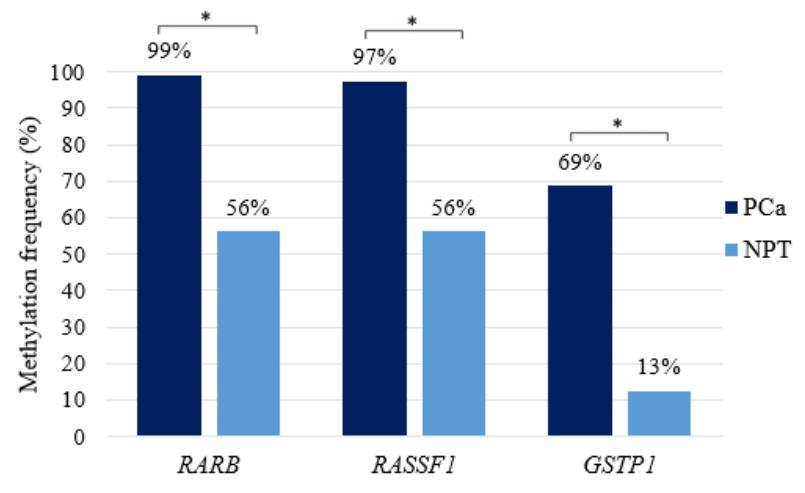
In conclusion, our analysis revealed frequent PCa-specific promoter methylation of RARB, RASSF1, and GSTP1, which might serve as novel epigenetic biomarkers for PCa diagnostics. Adding RARB, RASSF1, and GSTP1 promoter methylation status to currently used clinical tests has the potential to improve early prostate cancer detection. Further investigation is needed to validate the prognostic and predictive value of the proposed biomarkers.