Femtosecond laser induced chemical etching (FLICE) technology is a perspective field when applied to fabrication of micro devices. This technology consists out of two steps: 1) modification of the sample with femtosecond laser and 2) etching modified sample in chemicals [1]. FLICE method is being used to obtain various microstructures in glassy materials for micro-/nanofluidics and biofiltering.
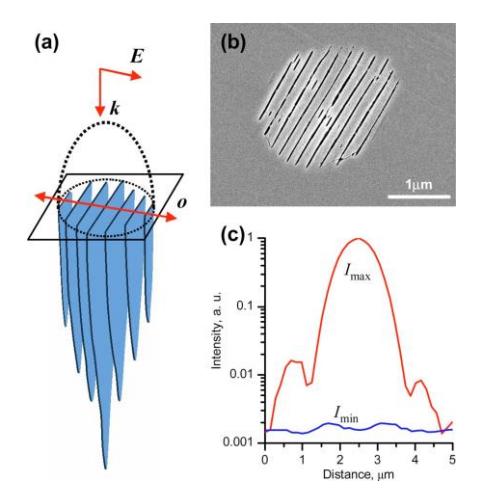
Formation of modified surface and volume structures in the glassy materials after irradiation with femtosecond pulses of various parameters was investigated by means of measuring induced retardance in the affected region. Parameters of the laser pulses like fluence, polarisation type, amplitude and phase distribution in the focal zone were varied to achieve modifications of desired size and orientation (Fig. 1).
It is known that etching rate correlates with the density of material, induced-stress and the refractive index [2] that depend on the laser pulse parameters. Based on this, modifications of Type II and Type III were induced to enhance interaction with the etchant. KOH was used to obtain channels or through holes and cuts. Density and temperature of the etchant was optimised to achieve maximal rate of etching.
There was wide set of modification and etching parameters used to achieve highest rate of etching in desired direction to leave unmodified regions as much intact as possible. Influence of combination of laser fluence, polarization and shape of the beam in focal zone was investigated to achieve minimal roughness of the etched channels and cuts.