
A cluster scattering MIMO channel model is proposed combining advantages of map-based models such as spatial consistency as well as stochastic properties of more general statistical models. The model is constructed by generating clusters based on LOS/NLOS visibility regions and generating stochastic MIMO channel coefficients according to temporal, spatial and spectral correlations between large and small scale fading parameters.
For constructing MIMO channel models two main approaches have been used: map-based deterministic models usually implemented using ray-tracing [1] and geometric stochastic models based on statistical properties of multipath fading correlation properties [2]. Recently a hybrid map-based and geometric stochastic models have received wide attention especially related to METIS channel model proposal [3, 4].
Line-of-sight or non-line-of-sight (LOS/NLOS) visibility conditions are required for radio wave propagation modeling to properly select empirical path loss model. For Monte Carlo statistical simulations a random generator of visibility states should be design according to a given spatial probability density. The radio channel model is constructed following 3GPP 3D channel model framework [5] for a stationary base station transmitter and mobile receiver in an urban scenario taking into account spatially consistent LOS/NLOS visibility state model.
In this way a discrete channel model is formed with time sampling interval corresponding to the Doppler frequency within each WSSUS path segment. This enables saving simulation time when processing slower paths without reducing the accuracy of the model.
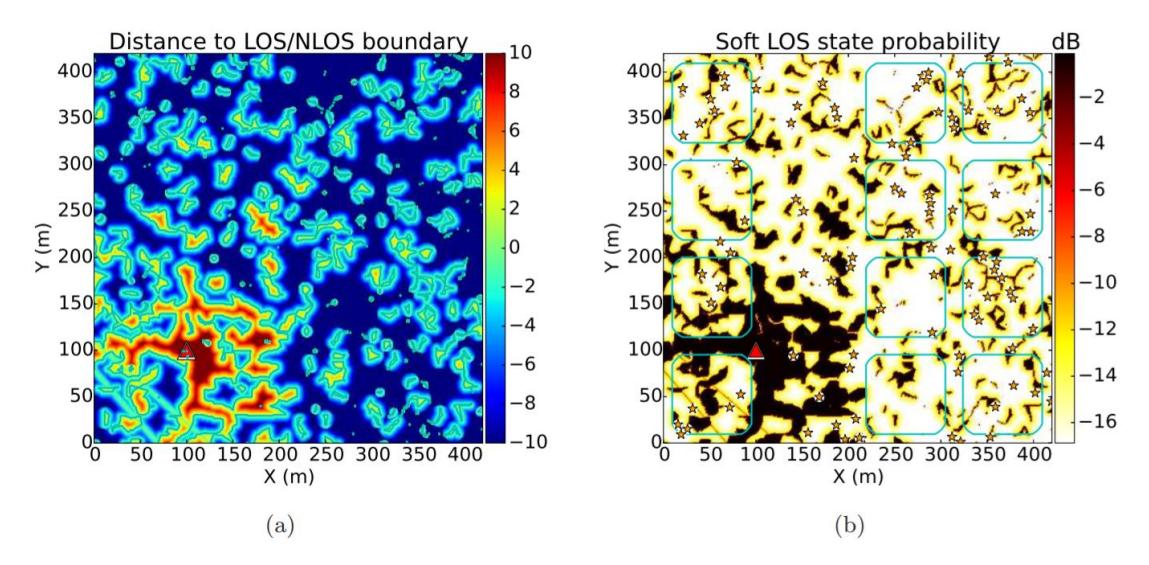
The presented MIMO channel model is based on a discrete statistical cluster scattering description but also takes advantage of spatial consistency via LOS/NLOS visibility zone assignment and large scale fading parameter generation. It can combine properties of stochastic and map-based channel models.
Being a discrete model it is suitable for efficient computer simulations. After splitting into WSSUS stationarity regions, the model can be applied in parallel to multi-processor systems by dividing whole path into array of route parts which can be processed independently.