
Graphene has rapidly established himself as intriguing building block for various optoelectronic applications. Graphene is an appealing material for photonics and optoelectronics because it offers several advantages compared with other materials. First, graphene is gapless. This enables charge carrier generation by light absorption over a very wide energy spectrum, unmatched by any other material. Furthermore, graphene exhibits ultrafast carrier dynamics, wavelength-independent absorption, tunable optical properties via electrostatic doping, low dissipation rates and high mobility, and the ability to confine electromagnetic energy to unprecedented small volumes [1].
In the current research, graphene films were synthesized on single and double copper foils (catalyst) by novel microwave plasma enhanced chemical vapor deposition technique (IPLAS, Germany). Methane and hydrogen gases mixture was used as a working gas at 30 mbar pressure, substrate temperature was 600 °C. For versatile inspections, in the sequel the transfer of formed graphene layers on different substrates (amorphous glass, quartz, PMMA, SiO2/Si) was performed by etching copper foil in different etchants at room temperature. Raman scattering spectroscopy (532 nm, inVia, Renishaw, UK) was used to control the technological process and the Raman scattering spectra confirmed successful transfer of the graphene films in a controllable way in the form of mono or multilayers. The transmittance measurements were carried out by means of UV/VIS spectrometer. Atomic force microscope (NanoWizard, Germany) analysis indicated the changes of graphene films morphology and integrity before and after the transfer.
Ultrafast excited state relaxation dynamics in graphene was studied by means of transient absorption spectroscopy (TAS). HARPIA spectrometer was used for TAS measurements. The samples were excited using a Pharos ultrafast Yb:KGW laser (Light Conversion) with a regenerative amplifier at a 66.7 kHz repetition rate and 290 fs duration pulses at 1030 nm wavelength. The pump beam wavelength was tuned with an Orpheus collinear optical parametric generator and harmonic generator Lyra (Light Conversion) to 350 nm and an energy density of 20.8 µJ/cm2. The samples were probed with a white light supercontinuum generated using a 2 mm thickness sapphire plate excited with a fundamental laser wavelength (1030 nm). The spectral range of the supercontinuum probe as well as the detection range of the TAS dynamics spanned wavelengths from 365 to 700 nm. The excitation beam was focused to an ~700 µm diameter spot, while the diameter of the supercontinuum probe was ~500 µm.
The samples of graphene transferred on PMMA substrate have shown the best quality TAS signal (Fig. 1).
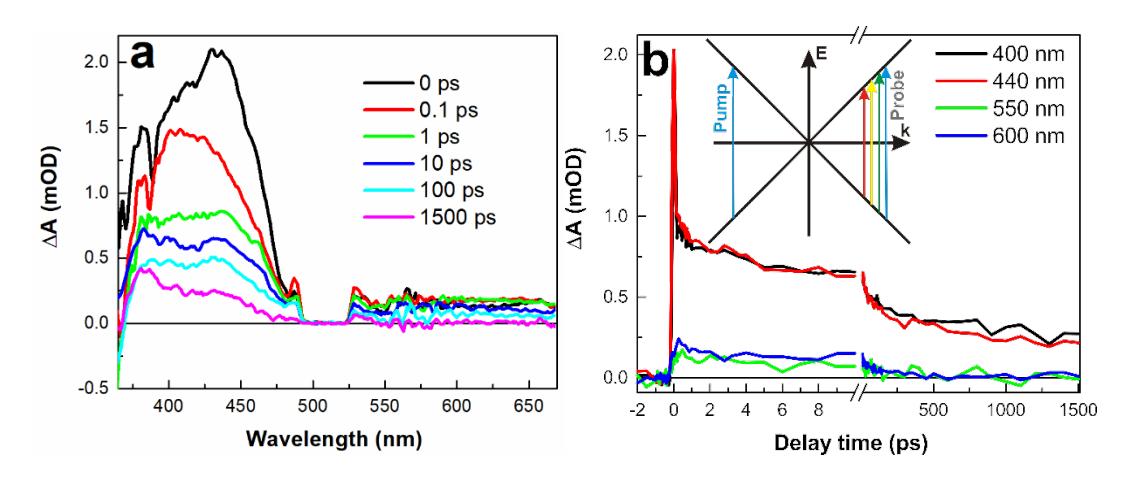
The data received during these measurements have indicated that ultrafast TAS relaxation traces consist of two parts the fast one (~1 ps) and slower one (~100 ps). The first duration of decay can be attributed to electron cooling by thermal equilibration with the lattice, while the second one to cooling of the lattice [2].