
The study of electronic properties of modified graphene is of a great demand in modern applied science within the trend of its application in future nanoelectronics [1]. In this work we study the influence of electrochemical deposition of cobalt nanoparticles on the electrical transport properties and parameters of weak localization of bilayer twisted graphene.
Sheets of twisted graphene $10 \times 10$ mm were fabricated by chemical vapor deposition (CVD) on 25 μm thick cooper foil (Alfa Aesar 99.8% purity) from the n-decane precursor with nitrogen as a carrier gas [2]. Electrochemical deposition of cobalt Co nanoparticles with an average diameter of 220 nm onto the surface of graphene on the Cu substrate was carried out in electrolyte contained 0.96 g/l of cobalt(II) sulphate heptahydrate CoSO4·7H2O and 0.064 g/l of sodium chloride NaCl at a constant current, at room temperature.
In order to study electrical properties, the sheets of twisted graphene were transferred onto the SiO2 substrate. Magnetoresistance R(B) of graphene samples (G/Si) and graphene with Co nanoparticles on substrate of SiO2 (Co-G/Si) was studied in the range temperature range T=4-300 K under magnetic field B up to 8 T. At temperatures T up 10 K samples do demonstrate typical field dependences of magnetoresistance typical for the weak localization phenomena. The approximation of experimental R(B) dependencies by expressions (1) and (2) allowed to estimate the characteristic times and lengths of coherence for charge carriers in graphene before and after the cobalt nanoparticles deposition.
$$\Delta \rho(B) = -\frac{e^2 \rho^2}{\pi \hbar} \left( F\left(\frac{B}{B_{\phi}}\right) - F\left(\frac{B}{B_{\phi} + 2B_i}\right) + \left(\frac{B}{B_{\phi} + B_*}\right) \right). \tag{1}$$$$F(x) = \ln x + \psi\left(\frac{1}{2} + \frac{1}{x}\right), B_{\phi,i,*} = \frac{\hbar}{4De} \tau_{\phi,i,*}^{-1}. \tag{2}$$
Here $\psi(x)$ is the digamma function; $\tau_{\phi}$ is the decoherence time; $\tau_i$ is the intervalley scattering time; $\tau_*^{-1} = \tau_w^{-1} + \tau_i^{-1}$, where $\tau_w$ is the time between scattering events [3, 4].
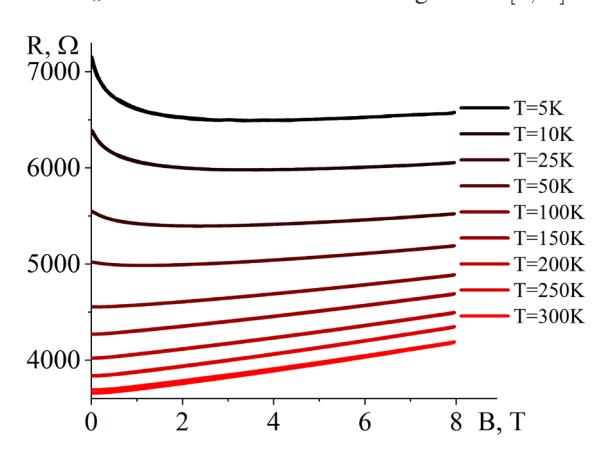
As is seen from Figures 1 and 2 the deposition of cobalt nanoparticles leads to the decrease of electrical resistance by an order of magnitude. It should be noted that the weak electron localization in studied system is caused by amorphous structure of grain boundaries between the crystallites of graphene [5]. Most likely, the increase of electrical conductivity and a decrease of negative magnetoresistance in samples (Co - G/Si) are caused by an interaction of cobalt nanoparticles with graphene underlayer and the shunting of the grain boundaries.
In summary, it was shown that in magnetic field B up to 0.2 T magnetoresistance of samples (G/Si) and (Co-G/Si) can be described by the theory of quantum corrections. The values of decoherence times and lengths for studied temperature range: $\tau_{\phi} \approx (0.6-2) \cdot 10^{-12}$ s and $L_{\phi} \approx (1-2) \cdot 10^2$ nm, and intervalley scattering times and lengths for the correction are: $\tau_{i} \approx (0.1-1) \cdot 10^{-13}$ s and $L_{i} \approx (0.2-5) \cdot 10^{1}$ nm.