
Silicon carbide (SiC) is a semiconducting material with a number of unique characteristics, such as chemical, thermal and radiation resistance, optically favorable band structure, elevated electron mobility and high break-down voltage. SiC has been intensively investigated all over the world for a long time, however till now it has too narrow range of applications in electronics. This is mainly due to a range of problems connected to defect-free growth of bulk SiC and production of wafers; as a result, the electronic-grade SiC substrates are too expensive for commercial mass-production. Epitaxial SiC films on silicon substrates have better prospects for electronic applications, however the growth of SiC/Si structures faces the problems of large lattice mismatch and very different thermal expansion constants which result in formation of dislocations, twins and stacking faults. Raman scattering yilds the information on crystalline phases and structural quality of solids and can therefore be used for routine examination of thin SiC films and SiC/Si interfaces. In the present work we applied Raman scattering for investigation of epitaxial SiC thin films, grown on a Si substrate with thin SiGe buffer layer on the surface.
The Si-wafes of (100) surface orientation with and without surface-located Si0.75Ge0.25 bufer layers are used in this study. The samples are chemically cleaned and the surface is refreshed in 5% HF+H2O solution just before carbonization. The growth of SiC layer is proceeded in a tungsten-foil-based heating cell. The cell is constructed in a vacuum chamber and is equiped with a thermocouple and two gas inputs. The growth of SiC layers is carried out in a vacuum better then 1·10-3Pa at the temperature of 1100°C during 10 min. The structural properties were investigated by Raman spectroscopy in backscattering configuration at room temperature with a Raman confocal microscope Nanofinder High End (Lotis TII, Belarus-Japan). Solid-state lasers at 473 or 532 nm were used for spectra excitation. Using chemical etching from the back side, the samples are prepared as thin SiC foils: This procedure allows to exlude influence of the substrate and to improve resolution of Raman spectra.
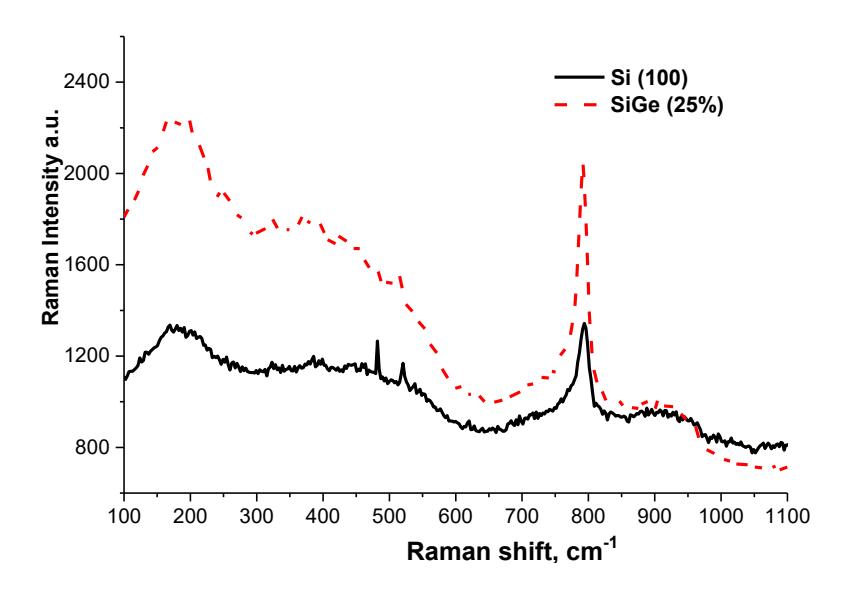
Analysis of raman spectroscopy spectra shows the presense of two silicon carbide phases which are 3C and 6H polytypes. It could be concluded that thermal treatment of the Si / SiGe buffer structure at 1100°C in a carbon atmosphere is accompanied by epitaxial growth of thin silicon carbide layers.